It really is a matter of proper scope, and consciousness of limits. Big Data is wonderful for finding the Higgs Boson among billions of particle paths, or tracking potential credit card fraud. It is not so good at many other tasks where the data is absent or incomplete or misleading. In those cases, it is little different from ancient farmers looking at the sky and seeing mythical animal patterns.The quest to draw useful insights from business measurements is nothing new. Big Data is a descendant of Frederick Winslow Taylor’s “scientific management” of more than a century ago. Taylor’s instrument of measurement was the stopwatch, timing and monitoring a worker’s every movement. Taylor and his acolytes used these time-and-motion studies to redesign work for maximum efficiency. The excesses of this approach would become satirical grist for Charlie Chaplin’s “Modern Times.” The enthusiasm for quantitative methods has waxed and waned ever since.
Big Data proponents point to the Internet for examples of triumphant data businesses, notably Google. But many of the Big Data techniques of math modeling, predictive algorithms and artificial intelligence software were first widely applied on Wall Street.
At the M.I.T. conference, a panel was asked to cite examples of big failures in Big Data. No one could really think of any. Soon after, though, Roberto Rigobon could barely contain himself as he took to the stage. Mr. Rigobon, a professor at M.I.T.’s Sloan School of Management, said that the financial crisis certainly humbled the data hounds. “Hedge funds failed all over the world,” he said.
The problem is that a math model, like a metaphor, is a simplification. This type of modeling came out of the sciences, where the behavior of particles in a fluid, for example, is predictable according to the laws of physics.
In so many Big Data applications, a math model attaches a crisp number to human behavior, interests and preferences. The peril of that approach, as in finance, was the subject of a recent book by Emanuel Derman, a former quant at Goldman Sachs and now a professor at Columbia University. Its title is “Models. Behaving. Badly.”
Tuesday, January 1, 2013
"Sure, Big Data Is Great. But So Is Intuition"

Monday, December 3, 2012
Art and Value
 by Michael Findlay, an art dealer who used to be head of Christie's in New York. He discusses the art market and how art is valued, broken into commercial value, social value and essential value.
 It's an interesting read. One of the things which is most striking (unsurprisingly) is the uncertainty of the enterprise. He quotes James Rosenquist, who said the process of art is " working like hell towards something you know nothing about." P175
Rosenquist also has a striking piece of advice for students:
Findlay argues there is social value in art, such as the benefits for families of having art in the home, the social circles it brings, the opportunity for philanthropy and legacies. I was thinking about small-time art on holiday in New Mexico back in the early summer, and much of the value of art far from the auction houses of London and New York is social and personal in character.Fine art is not a career. You may be very good and no one looks at your work until you are dead. Most artists don't cut it. I have had thirty-five assistants in the course of my fifty years as a painter and not one of them has achieved any success as an artist. What you need is luck. Nothing is guaranteed or automatic. P175
Of course, as Findlay is a former leading auctioneer, his description of the commercial process of valuing art is very interesting and makes up most of what is absorbing about the book.
Naturally, considerations of quality and - especially - rarity apply. Dealers will know which private individuals own what, and which paintings may come back on the market in the next ten years. Provenance, condition, whether it was an "important" point in an artists' career, whether it has been shown in prominent musuem exhibitions, even previous ownership make a difference to valuation.
But so much has to do with titanic waves of wealth and booms in the art market. It is more a story of the vagaries (and pathologies) of the super-wealthy more than anything else, despite his occasional claims that anyone can collect art. It is a story of substantial extra spending by the auction houses on PR, glossy catalogues and private dinner parties in the last twenty years, and broad shifts in taste and fashion.
Art can overlap with branding and short-term financial speculation, although art investment funds, interestingly, almost never do well. Most of the market is still private, without public auction prices, he says. And choosing the few artists who will do well out of thousands is hard. And then sellers find the market is illiquid and the transaction costs enormous.
He comes from a side of the business which has to be able to make valuations which will satisfy IRS scrutiny for tax purposes, or insurance: a very prosaic angle of a very ephemeral and glamorous field. And purely financial motives are most often self-defeating.
The heart of it is the boundary of practical and eternal value - auction day stories and logistics and snobbery as against insight and talent and beauty.
He insists in the end perception is more important than information; art history, gallery labels, knowledge about the artist or the market are no substitute for, and can't replace, the experience of sustained attention to a piece of art.
Ultimately, he argues, there is essential value to the greatest art. it does not necessarily come from the twenty second glance that is usual in art galleries, however. Indeed, that may be the advantage of collecting and owning, he says: you get to live with a work of art. You get to feel it over time, rather than just have a right-brained summation of information in a quick glance.
Language can be a barrier. He quotes Barnett Newman: "The meaning must come from the seeing, not the talking."
It all sets up in clear terms the deeper issue of "what is value?", which economics often struggle with, as we shall see next.
Tuesday, November 20, 2012
Futility and stock-picking
Just as in 2011, only about 1 in 5 active managers are beating their benchmarks in a year marked by the same type of headline volatility caused by events in Europe and fiscal concerns closer to home.
While the advantage of passive over active is nothing new, the near-record level of futility is, and the cracks are beginning to show.
[...]
Political factors are about decisions and perception, not ratios."The market is being driven by macro factors," Flam said. "So most professional advisors have a background in evaluating companies, industries, economies. It's not in politics, and politics is what dominating the markets over the last couple of years."
Sunday, November 11, 2012
Rationality and Sustainability
He says:
That is a much better way to look at things than narrow internal homo economicus consistency. Instead, there ought to be some reflection and an ability to sustain an argument against external argument.Rationality of choice.. Is primarily a matter of basing our choices - explicitly or by implication - on reasoning we can reflectively sustain if we subject them to critical scrutiny. (p179-180)
Saturday, November 10, 2012
Mind blindness & Unknown unknowns
 , starting here. The extra attention is justified by how well-written and fruitful the book is.
 I've naturally come across (Nobel Economics Laureate)Thomas Schelling before, especially his ground-breaking The Strategy of Conflict
 . But Silver uncovers some writings of his I hadn't come across, in a preface to the book Pearl Harbor: Warning and Decision
 by Roberta Wohlstetter.
Schelling writes of our propensity to mistake the unfamiliar for the improbable: There is a tendency in our planning to confuse the unfamiliar with the improbable. The contingency we have not considered seriously looks strange; what looks strange is thought improbable; what is improbable need not be considered seriously.
We have an inherent tendency as human beings to develop kinds of mind-blindness. I love that term.But at least this flawed type of thinking would have involved some thinking. If we had gone through the thought process, perhaps we could have recognized how loose our assumptions were. Schelling suggests that our problems instead run deeper. When a possibility is unfamiliar to us, we do not even think about it. Instead we develop a sort of mind-blindness to it. In medicine this is called anosognosia:part of the physiology of the condition prevents a patient from recognizing that they have the condition. Some Alzheimer’s patients present in this way.
And perhaps the biggest flaw of all is to believe the future is more predicable or controllable than it really is.
There is reason to suspect that of the various cognitive biases that investors suffer from, overconfidence is the most pernicious. Perhaps the central finding of behavioral economics is that most of us are overconfident when we make predictions. The stock market is no exception; a Duke University survey of corporate CFOs,whom you might expect to be fairly sophisticated investors, found that they radically overestimated their ability to forecast the price of the S&P 500.
Heuristics
So what can we do? What we need is heuristics:In a complex an confusing world, I think good heuristics may be the best we can hope for.We can think of these simplifications as “models,” but heuristics is the preferred term in the study of computer programming and human decision making. It comes from the same Greek root word from which we derive eureka.A heuristic approach to problem solving consists of employing rules of thumb when a deterministic solution to a problem is beyond our practical capacities.
It really is a very thoughtful and insightful book covering a wide range of issues. Silver clearly has deep talent far beyond baseball statistics and election forecasting.
Friday, November 9, 2012
Prediction and Bayesian testing
, which I have been looking at starting here. I argued in this post the other day that what we need for predictive success is not so much big data as self-awareness. Hypothesis testing ought to help us revise our point of view.
Silver rightly emphasizes prediction is largely a means to an end:
I keep talking about the importance of purpose, for example here about the difference between maps and models.The philosophy of this book is that prediction is as much a means as an end. Prediction serves a very central role in hypothesis testing, for instance, and therefore in all of science.As the statistician George E. P. Box wrote, “All models are wrong, but some models are useful.” What he meant by that is that all models are simplifications of the universe, as they must necessarily be. As another mathematician said, “The best model of a cat is a cat.”Everything else is leaving out some sort of detail. How pertinent that detail might be will depend on exactly what problem we’re trying to solve and on how precise an answer we require.
The potential pitfalls mean we have to know ourselves, says Silver:
This is why it is so crucial to develop a better understanding of ourselves, and the way we distort and interpret the signals we receive, if we want to make better predictions.
Frequentism
However, much recent statistics has run well and truly off the rails by assuming that error arises from our measurements rather than our perception or judgement. Silver criticizes simple-minded statistical "frequentism", which he says mostly stems from nineteenth century English statistician Ronald Fisher.The idea is you can act as if you can repeat an experiment innumerable times. The more random experiments you do, the more accurate the outcome.The idea behind frequentism is that uncertainty in a statistical problem results exclusively from collecting data among just a sample of the population rather than the whole population.
Essentially, the frequentist approach toward statistics seeks to wash its hands of the reason that predictions most often go wrong: human error. It views uncertainty as something intrinsic to the experiment rather than something intrinsic to our ability to understand the real world. The frequentist method also implies that, as you collect more data, your error will eventually approach zero: this will be both necessary and sufficient to solve any problems. Many of the more problematic areas of prediction in this book come from fields in which useful data is sparse, and it is indeed usually valuable to collect more of it. However, it is hardly a golden road to statistical perfection if you are not using it in a sensible way. As Ioannidis noted, the era of Big Data only seems to be worsening the problems of false positive findings in the research literature.
Frequentism dominated statistics in the twentieth century. Fisher criticized Bayesian statistics (which we will come to in a moment) for beng insufficiently objective. But, says Silver,
Plenty of investors have lost their shirts by having risk models which assume that market events follow a neat normal ( or similar ) distribution.Nor is the frequentist method particularly objective, either in theory or in practice. Instead, it relies on a whole host of assumptions. It usually presumes that the underlying uncertainty in a measurement follows a bell-curve or normal distribution. This is often a good assumption, but not in the case of something like the variation in the stock market. The frequentist approach requires defining a sample population, something that is straightforward in the case of a political poll but which is largely arbitrary in many other practical applications. What “sample population” was the September 11 attack drawn from? The bigger problem, however, is that the frequentist methods—in striving for immaculate statistical procedures that can’t be contaminated by the researcher’s bias—keep him hermetically sealed off from the real world. These methods discourage the researcher from considering the underlying context or plausibility of his hypothesis, something that the Bayesian method demands in the form of a prior probability. Thus, you will see apparently serious papers published on how toads can predict earthquakes, or how big-box stores like Target beget racial hate groups,which apply frequentist tests to produce “statistically significant” (but manifestly ridiculous) findings.
Bayesian Probability
Instead, Silver strongly advocates the older Bayesian statistics. In essence, one must specify a prior probability of an outcome , based on one's current beliefs. Bayes' formula then specifies how you should alter that probability in response to incoming data and events, which produces a posterior probability. It is about recognizing your current expectations and beliefs, amd learning from new evidence.We took a step backwards when frequentism arose.The Bayesian viewpoint, instead, regards rationality as a probabilistic matter. In essence, Bayes and Price are telling Hume, don’t blame nature because you are too daft to understand it: if you step out of your skeptical shell and make some predictions about its behavior, perhaps you will get a little closer to the truth.
For me, the point about Bayesian probability ( which I haven't ever used professionally) is not so much the math but a procedure which requires you to test and revise your beliefs in response to evidence. I think Silver overdoes Bayesian probability as THE answer, but his main target in his own intellectual world is likely very much the frequentists. He is a statistician. So we can understand his emphasis on an alternative statistical tradition.As we will see, science may have stumbled later when a different statistical paradigm, which deemphasized the role of prediction and tried to recast uncertainty as resulting from the errors of our measurements rather than the imperfections in our judgments, came to dominate in the twentieth century.
Incidentally, I am no statistician, but I have been intrigued in the past by Keynes' arguments in his A Treatise on Probability (Classic Reprint)
 , but I'll leave that for another time.
Thursday, November 8, 2012
Blaming a whale (and narrative) for defeat
David: This might be a good time for Republicans to redouble their commitment to the reality-based community. Did you see Byron York's reporting from inside the Romney campaign? They apparently had this giant computer model called Orca - named after a whale because it was bigger than anything the Democrats could imagine. It processed huge amounts of data and late in the day was still projecting a Romney victory until its head exploded. Garbage in. Garbage out.
I think that some people are a little transfixed by Nate Silver's accurate projection of the election, despite, as I've noted, his own much more self-awade mature grasp of the limits of models.Gail: The Republican Orca - stop me before I fall into a great pile of Moby Dick analogies.
I think this is at root a particular problem with journalism.
Or, to put it more precisely, it is a problem with narrative. Human beings have a hardwired fascination with stories, probably dating from sitting around fires in the savannah fifty thousand years ago. It is often the prime way we transmit culture and values and pointers for behavior we should admire.
But stories can be too trite, and this is where journalism becomes very hedgehog-like sometimes. It is all to easy to link stories into an appealing broader narrative, to instinctively frame things in a way which makes for an entertaining read. Stories are much more interesting than data. Once you go looking for "stories", as opposed to drier mechanical reporting of facts, you introduce potential blindspots. Things can fit all too neatly into narrative buckets.
Journalism thrives on stories. Journalists are paid to look for them, rather than dry, ambiguous, complicated truth in isolation.
We've also seen that hedgehogs typically get more media attention, because big striking claims typically make better tv or better stories. Hedgehogs want an audience for their "one big thing." Journalists want a story, And "triumph of models" is itself a good story.
Of course, at the same time as the fivethirtyeight model did well, the Romney and other models performed badly. But why let that get in the way of a good story?
Self-awareness
This is the real explanation of Silver's greater success here. It is not so much a data-driven approach, as using the data to confront your presuppositions. That is why he does better than most journalists and opinion pundits.It is not, as the story linked above puts it, simply a matter of primitive punditry against spanking new "data driven rationality".
The scientific method is at root about testing hypotheses, not mining data. You test a prediction or explanation against reality, and you revise your views if necessary based on the outcome. You can selectively use data to confirm all kinds of things if you are not careful. So you need to have a falsifiable hypothesis, a situation where at least in principle you may be forced to revise your view.
There's nothing in narrative that compels you to change your view, because you can always add a twist in the story. Indeed, most good stories will have the hero endure many setbacks and misunderstandings before being proved right in the end.
Even in science, as Thomas Kuhn famously pointed out in The Structure of Scientific Revolutions
 , conflicting data is often left aside as a "puzzle" or "anomaly" in periods of normal science until there is a sudden change of awareness: I.e. the "paradigm shift" which has become so overused a term it is almost a clichė. Even in the hard sciences, it can take a generation for data to settle arguments one way or another. Theories can sprout dozens of ad-hoc adjustments.
So data can be part of this process of self-awareness. But in a world where we have a blizzard of often conflicting and imperfect data, it may equally reinforce entrenched views.
Romney's big Moby Dick model was probably highly sophisticated, but likely being used to mine data more efficiently, not testing against reality.
Innumerate journalists may regard the statistical models as some sort of new semi-deity, partly because they don't understand it, or the many ways in which statistics can be used to obscure. (There is a famous book called How to Lie with Statistics
 ).
).But the real message is not statistics as some kind of new rational technique which guarantees prophetic success. Instead, it is self-awareness.
You need devices to help you retain self-awareness, to see things as they really are instead of ever-more elaborate stories or models. And humans typically find that very hard to do. I've got a few more things to say about Silver's book in that light.
Wednesday, November 7, 2012
Morality binds and blinds
Each side finds it difficult to see the other's sacred values, he says. So conservatives tend to deny climate change, for example. Liberals tend to deny potential problems with entitlement spending.A basic principle of moral psychology is that “morality binds and blinds.” In many pre-agricultural societies, groups achieved trust and unity by circling around sacred objects. In modern societies, much larger groups bind themselves together by treating certain books, flags, leaders or ideals as sacred and by symbolically circling around them. But if your team circles too fast, you lose the ability to see clearly or think for yourself. You go blind to evidence that contradicts your group’s moral consensus, and you become enraged at teammates who suggest that the other side is not entirely bad (as New Jersey’s governor, Chris Christie, is now finding out).
Unlike a foreign attack, a problem that threatens only one side’s sacred values can therefore divide us, rather than unite us.
But there are so many "asteroids" about to hit us in coming years that necessity may force each side to recognize some merit in other views. That may mean more attention to economic inequality and the fact that the family has eroded - 40% of births are to unwed mothers, for example.
I think that is a civilized comment for the morning after the election. At least we can be thankful for the country's sake that there has been no hanging chad dramas and Obama won the popular vote as well as the electoral college.
More reaction from me when I'm a bit less tired and have time to absorb it.
Tuesday, November 6, 2012
Maps, not models, by Mapper
, starting here. There's one stray reference in the book, which caught my eye, because I've been interested for over a decade in the difference between maps and models as ways to understand the world. I call myself Mapper on this blog for a reason.
Silver says:
I hadn't head of Kokko before, but I thought this was interesting. The reason I find the topic so fascinating is that I have sat many times in meetings with senior economic officials - or even more often, their more academic staff - who argue that to think clearly about a situation you need a model in your head, if only to ensure consistency. For most economists, this tends to be linked to some version of Milton Friedman's as-if methodology, which says that the test of a model is not the realism of its assumptions, but the accuracy of its predictions. Simplification and abstraction from reality is what constitutes explanation, and anything else is mere muddle.The Finnish scientist Hanna Kokko likens building a statistical or predictive model to drawing a map. It needs to contain enough detail to be helpful and do an honest job of representing the underlying landscape—you don’t want to leave out large cities, prominent rivers and mountain ranges, or major highways. Too much detail, however, can be overwhelming to the traveler, causing him to lose his way. As we saw in chapter 5 these problems are not purely aesthetic. Needlessly complicated models may fit the noise in a problem rather than the signal, doing a poor job of replicating its underlying structure and causing predictions to be worse. But how much detail is too much—or too little? Cartography takes a lifetime to master and combines elements of both art and science. It probably goes too far to describe model building as an art form, but it does require a lot of judgment. Ideally, however, questions like Kokko’s can be answered empirically. Is the model working? If not, it might be time for a different level of resolution.
Of course, this automatically counts out the value of studying history, which has been largely excluded from the mainstream of education in the discipline for fifty years (despite some good work). Mathematical models have reigned supreme. Optimization subject to constraints is the center of thinking. It is far narrower than even "theory", as it imposes essentially aesthetic constraints on what a theory should be, I.e. mathematically elegant.
It also is dangerously overreliant on consistency. You need to be consistent to be fully rational in your choices, of course, in a narrow sense. But consistency is no guarantee of truth. You can be consistently wrong. And many actual problems are about reconciling different objectives or opposing views. Compromise in this sense is bound to be somewhat inconsistent with someone's basic principles. It is also real life.
However, the most important point is the economic modeling perspective is also a very naive way to think about useful abstraction. A map is an abstraction too, but it tends to be much more useful for most purposes than a mathematical model. Many policy problems are in fact much more like "how to get from A to B" than " maximize X subject to Y".
In particular, maps are much more focused on specific purposes. If I want to get from New York to Albany, I look at a standard road atlas or Google maps. If I want to see where shale gas deposits may lie, I want a geological map of New York State. If I want to sail up the Hudson to Albany, I want a chart which shows sandbanks and shoals and traffic lanes in the river.
In other words, purpose is much more intrinsically present in a map than a mathematical model using aggregate economic statistics or optimization assumptions.
Add to that, as Kokko says, the scale and resolution which are inherent to maps. You abstract away what you don't need. He is right here, but both Silver and Kokko are wrong in a larger sense. The point is not that there is an art to building models so they are , by analogy, a little more like maps with a correct level of detail. It is that maps and models are wholly different ways to understand reality.
Maps are much more suited to seeing risks. The kind of generalized abstraction in a model will not help you avoid the specific rock which is just below the surface as you enter harbor, but the right chart will. A map will show you the massive mountain chain or desert or unfordable river in your way. It will show the paths and cliffs and hazards. A model won't.
So thinking in terms of surveying a specific landscape for specific important features for a specific purpose is just as disciplined an intellectual exercise as developing an abstract model to predict, and much more useful. It can also be a much better predictor of some kinds of problem (eg how long it will take to get to Albany.)
Maps help you see what is actually there, rather than "explain" it in some ultimate universal way. We most often don't need a general theory of roads. We just want to find our way home. Models will predict, but maps will show you the right way. If you want to climb a mountain you are better off bringing a topo map than an abstract mathematical model of paths.
Silver's book is all about prediction, but the more general human problem in decision-making is which way do I go? What is the right direction? Where are the hazards? We need maps more than universalized explanations in most situations. We need a survey of the actual landscape with a particular purpose in mind.
Ways of seeing what is really there are the main way we will develop and make progress. Too much modelling often prevents us from doing that, by distracting people towards the mathematically elegant and tractable, the thin universal rather than the thick description of specifics, and the quantifiable and obvious rather than the danger that lurks in the details.
Monday, November 5, 2012
Economic forecasts
, starting here.One other area which has experienced consistent failure is economic forecasting. I cite what Silver says here with a certain amount of glee. Of course, I know this as background information, but to see the hard facts marshalled together is striking. Take a survey economic forecasts in 2008, for instance.
Nor was this a once-off occurrence because of a freak once-in-a-lifetime crisis.As I mentioned, the economists in this survey thought that GDP would end up at about 2.4 percent in 2008, slightly below its long-term trend. This was a very bad forecast: GDP actually shrank by 3.3 percent once the financial crisis hit. What may be worse is that the economists were extremely confident in their bad prediction. They assigned only a 3 percent chance to the economy’s shrinking by any margin over the whole of 2008.15 And they gave it only about a 1-in-500 chance of shrinking by at least 2 percent, as it did.
Aggregate forecasts tend to be more reliable than individual forecasts, however. This has been bad news for in-house corporate economists, who were mostly eliminated in the 1990s. Bluechip or Consensus Forecasts are better.In fact, the actual value for GDP fell outside the economists’ prediction interval six times in eighteen years, or fully one-third of the time. Another study,18 which ran these numbers back to the beginnings of the Survey of Professional Forecasters in 1968, found even worse results: the actual figure for GDP fell outside the prediction interval almost half the time. There is almost no chance that the economists have simply been unlucky; they fundamentally overstate the reliability of their predictions.
Perhaps the new availability of computers made forecasters particularly overconfident in the 1960s and 1970s, he says - the age of the massive economic forecasting model. But ultimately you have to have some theoretical understanding or you will sink into mere data mining, he says.My research into the Survey of Professional Forecasters suggests that these aggregate forecasts are about 20 percent more accurate than the typical individual’s forecast at predicting GDP, 10 percent better at predicting unemployment, and 30 percent better at predicting inflation. This property—group forecasts beat individual ones—has been found to be true in almost every field in which it has been studied.
Economics has inherent limitations on theory, however. One of the decisive intellectual impacts on me in college was learning about the Lucas Critique, which says people's behavior may change when policy changes, so you cannot rely on large-scale econometric relationships. I lost interest in econometrics and forecasting.The idea that a statistical model would be able to “solve” the problem of economic forecasting was somewhat in vogue during the 1970s and 1980s when computers came into wider use. But as was the case in other fields, like earthquake forecasting during that time period, improved technology did not cover for the lack of theoretical understanding about the economy; it only gave economists faster and more elaborate ways to mistake noise for a signal. Promising-seeming models failed badly at some point or another and were consigned to the dustbin.
The economics profession has mostly responded to this problem by searching for policy-invariant microfoundations. It tries to model individial choice, far below the level of economic aggregates. In practice, this mostly entrenches naive rational-choice mathematical optimization even further.
A better answer to this is deeper knowledge of history. At least some people in the central banks note that we are fortunate that Ben Bernanke was an acknowledged expert in the history of the Great Depression, rather than, say, real business cycle models.
Sunday, November 4, 2012
Overfitting models
, starting here. Silver discusses some of the inherent problems and mistakes people make with statistical models.One of the most important is overfitting.
It can lead to serious problems.The name overfitting comes from the way that statistical models are “fit” to match past observations. The fit can be too loose—this is called underfitting—in which case you will not be capturing as much of the signal as you could. Or it can be too tight—an overfit model—which means that you’re fitting the noise in the data rather than discovering its underlying structure. The latter error is much more common in practice.
This is one of the great stories of financial markets. People are forever trying to come up with the equivalent of quantitative alchemy to transform historical data into gold. It is quite easy to tune a model so it performs very well on past data, and marches undulations with surprising precision. And it is amazingly easy to lose your shirt when the model goes awry when used to predict where the market will go next.As obvious as this might seem when explained in this way, many forecasters completely ignore this problem. The wide array of statistical methods available to researchers enables them to be no less fanciful—and no more scientific—than a child finding animal patterns in clouds.* “With four parameters I can fit an elephant,” the mathematician John von Neumann once said of this problem. “And with five I can make him wiggle his trunk.” Overfitting represents a double whammy: it makes our model look better on paper but perform worse in the real world. Because of the latter trait, an overfit model eventually will get its comeuppance if and when it is used to make real predictions.
Foxes and Hedgehogs
, starting here. He is very controversial right now, immediately before the election, because of his prediction of a much higher chance of an Obama victory than the headline polls indicate. So he will be seen by many in partisan terms. The book is not partisan, however, so it deserves a fair look by people who might fight over his NY Times articles. After all, Silver argues for skepticism about expert predictions as a general rule.
I've mentioned Philip Tetlock's work on political prediction before. Tetlock found that most prediction by political or international relations experts is terrible. As Silver puts it,
But Tetlock also found one distinction that pointed to more successful forecasts. Isaiah Berlin had revived the ancient distinction between hedgehogs, who know one big thing, and foxes, who know many small things. I've mentioned it many times. Silver puts it nicely:Tetlock’s conclusion was damning. The experts in his survey—regardless of their occupation, experience, or subfield—had done barely any better than random chance, and they had done worse than even rudimentary statistical methods at predicting future political events. They were grossly overconfident and terrible at calculating probabilities: about 15 percent of events that they claimed had no chance of occurring in fact happened, while about 25 percent of those that they said were absolutely sure things in fact failed to occur. It didn’t matter whether the experts were making predictions about economics, domestic politics, or international affairs; their judgment was equally bad across the board.
Hedgehogs have more trouble seeing what is there without predispositions.Hedgehogs are type A personalities who believe in Big Ideas—in governing principles about the world that behave as though they were physical laws and undergird virtually every interaction in society. Think Karl Marx and class struggle, or Sigmund Freud and the unconscious. Or Malcolm Gladwell and the “tipping point.” Foxes, on the other hand, are scrappy creatures who believe in a plethora of little ideas and in taking a multitude of approaches toward a problem. They tend to be more tolerant of nuance, uncertainty, complexity, and dissenting opinion. If hedgehogs are hunters, always looking out for the big kill, then foxes are gatherers. Foxes, Tetlock found, are considerably better at forecasting than hedgehogs.
Hedgehogs are vey good at coming up with stories and narratives that validate their positions - and turn out to be wrong.Foxes may have emphatic convictions about the way the world ought to be. But they can usually separate that from their analysis of the way that the world actually is and how it is likely to be in the near future. Hedgehogs, by contrast, have more trouble distinguishing their rooting interest from their analysis. Instead, in Tetlock’s words, they create “a blurry fusion between facts and values all lumped together.” They take a prejudicial view toward the evidence, seeing what they want to see and not what is really there.
I am, as you might imagine from reading this wide-ranging blog, a fox to the core. I like to take ideas from different disciplines, and recombine and synthesize. So of course I like this argument. Hedgehogs often suffer from serious blind spots, and are prone to fanaticism.The foxy forecaster recognizes the limitations that human judgment imposes in predicting the world’s course. Knowing those limits can help her to get a few more predictions right.
One issue I haven't seen addressed anywhere, though, is what makes people foxes or hedgehogs. Part of it must be personality, although it's difficult to see a direct link to the big five theories of personality. There is some evidence that liberals tend to have higher openness to experience, but in my experience liberals are if anything more prone to ideological narrowness than conservatives. Conservatives often have a skepticism about systems and experts and theory which might make at least some less prone to hedgehog temptation. But one can find ideologues and zealots across the political spectrum. It is a sensibility rather than a particular political conviction.
Some of it must be a matter of education and styles of learning. And some must be a reflection of the incentives we set up. As Tetlock says, you are likely to be a more successful TV pundit by making overconfident big pronouncements than being nuanced.
In any case, Silver's point is that hedgehogs tend to be worse at prediction, not necessarily worse in general. Some of the most gifted people are hedgehogs by nature. As I've said before, Plato was a hedgehog, Aristotle a fox ( which may explain why I've become so interested in Aristotle). Dante was a hedgehog, Shakespeare a fox. Systems have their place. But we do need a feel as a society for the boundaries and limits and clashes of systems.
People like to believe in more certainty than there really is.
Friday, October 26, 2012
Signal, Noise and Prediction
. Silver is the well-known political forecaster who parlayed his blog FiveThirtyEight into a prominent spot in the New York Times. I didn't expect much when I bought it. I thought it would be one of those "my quantitative model explains the universe" books (and investment funds) which are so tiresome and common. The world, and especially the markets, are filled with quants who think all you need is Mathematica and some back issues of Econometrica to explain everything. They are usually overconfident, expert on code rather than decisions,and tend to blow up spectacularly like LTCM given time.
Nothing could be further from the truth in this case. The book massively exceeded expectations and turns out to be a thoughtful, mature and reflective. It is consistent with much of my experience and thinking, but I still learned a lot of things I didn't know. It's also fluent and well-written. I'd recommend it without hesitation, and I'll look at it in some detail.
The crux of the book, from someone known for his number-crunching models, is that there is no such thing as objective data-driven models, at least in human affairs.
The more information we have, the more we tend to screen out that which does not match our preconceptions. More information most often makes us narrower rather than wiser.The numbers have no way of speaking for themselves. We speak for them. We imbue them with meaning. Like Caesar, we may construe them in self-serving ways that are detached from their objective reality. Data-driven predictions can succeed—and they can fail. It is when we deny our role in the process that the odds of failure rise. Before we demand more of our data, we need to demand more of ourselves.
Information is no longer scarce, but much of it is not very useful.Alvin Toffler, writing in the book Future Shock in 1970, predicted some of the consequences of what he called “information overload.” He thought our defense mechanism would be to simplify the world in ways that confirmed our biases, even as the world itself was growing more diverse and more complex.
This does not mean we should just give up, or adopt lazy relativism. Instead, everything is approximate.Our biological instincts are not always very well adapted to the information-rich modern world. Unless we work actively to become aware of the biases we introduce, the returns to additional information may be minimal—or diminishing.
So what are the causes of failure to predict outcomes?Some of you may be uncomfortable with a premise that I have been hinting at and will now state explicitly: we can never make perfectly objective predictions. They will always be tainted by our subjective point of view. But this book is emphatically against the nihilistic viewpoint that there is no objective truth. It asserts, rather, that a belief in the objective truth—and a commitment to pursuing it—is the first prerequisite of making better predictions. The forecaster’s next commitment is to realize that she perceives it imperfectly.
Indeed, experts have a particular tendency to ignore threats to their expertise. The rating agencies, for example, did not think through the possibility that default risk of various CDOs and CDO tranches might not be independent and uncorrelated.The most calamitous failures of prediction usually have a lot in common. We focus on those signals that tell a story about the world as we would like it to be, not how it really is. We ignore the risks that are hardest to measure, even when they pose the greatest threats to our well-being. We make approximations and assumptions about the world that are much cruder than we realize. We abhor uncertainty, even when it is an irreducible part of the problem we are trying to solve.
Our expectations about the future are riddled with blind spots, as anyone who has ever really thought about the policy process or had to predict events for a living - and been held accountable for it - knows.The possibility of a housing bubble, and that it might burst, thus represented a threat to the ratings agencies’ gravy train. Human beings have an extraordinary capacity to ignore risks that threaten their livelihood, as though this will make them go away.
We'll look at some other aspects of the book in more detail.
Saturday, October 13, 2012
Montaigne and How to Live
 last week. It is an original and beautifully written biography, but more than that: it not only looks at Montaigne's life and writings, the book also traces how their reception and meaning has changed in succeeding centuries. That adds a whole additional layer of complexity, exploring how different ages have reinterpreted the same ideas in different ways.
Of course, I have Michel de Montaigne - The Complete Essays
 on my shelf, but must admit I hadn't read much of its rather intimidating bulk. Bakewell's book certainly inspires a return to the original.
The reason I picked up the Bakewell book, besides serving as an easier way into the thousand pages of the Essays, is because she reminds us that Montaigne's central question is how to live. I often talk about how we have let serious discussion of the good life lapse. That discussion is very much present in the Essays.
He is endlessly curious about other people.
Reason, for Montaigne, cannot be relied upon, because it is still inevitably human reason. Things must be seen as intrinsically uncertain and provisional.Moral dilemmas interested Montaigne, but he was less interested in what people ought to do than in what they actually did. He wanted to know how to live a good life—meaning a correct or honorable life, but also a fully human, satisfying, flourishing one. This question drove him both to write and to read, for he was curious about all human lives, past and present. He wondered constantly about the emotions and motives behind what people did. And since he was the example closest to hand of a human going about its business, he wondered just as much about himself.
He is a fox to the core, suspicious of systems. Bakewell brings out the context for Montaigne's humane skepticism about the fallibility of human capacities and the mind: the appalling violence and cruelty and bigotry that tore France apart in his lifetime.Skepticism guided him at work, in his home life, and in his writing. The Essays are suffused with it: he filled his pages with words such as “perhaps,” “to some extent,” “I think,” “It seems to me,” and so on—words which, as Montaigne said himself, “soften and moderate the rashness of our propositions,” and which embody what the critic Hugo Friedrich has called his philosophy of “unassumingness.” They are not extra flourishes; they are Montaigne’s thought, at its purest. He never tired of such thinking, or of boggling his own mind by contemplating the millions of lives that had been lived through history and the impossibility of knowing the truth about them.
Protestants and Catholics massacred each other and demobilized soldiers roamed the countryside stealing and killing.There was a tiredness and a sourness in Montaigne’s generation, along with a rebellious new form of creativity. If they were cynical, it is easy to see why: they had to watch the ideals that had guided their upbringing turn into a grim joke. The Reformation, hailed by some earlier thinkers as a blast of fresh air beneficial even to the Church itself, became a war and threatened to ruin civilized society. Renaissance principles of beauty, poise, clarity, and intelligence dissolved into violence, cruelty, and extremist theology.
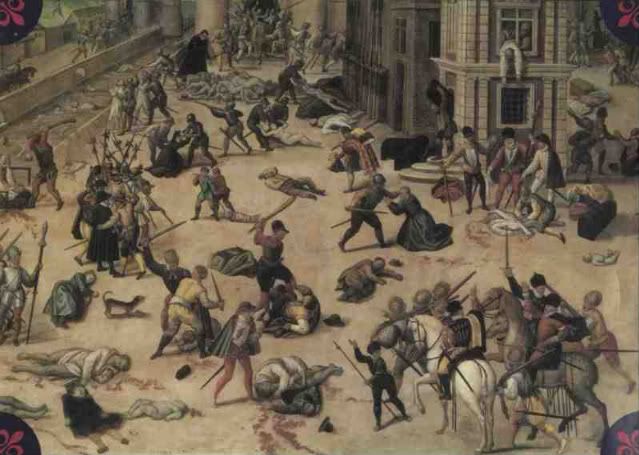
This is not directly visible in the Essays, on the whole; but the general sensibility of awareness of human fallibility and search for equilibrium must be a reaction to the turbulent horror of the times.
The answer is, in part, to be sensitive to different angles of view. The wise do not just accept their surrounding assumptions.
I find this very congenial, as aspect-seeing or different ways of seeing is something that fascinates me. The world's problems are generally not so much a lack of theoretical or academic understanding, as failure to perceive what is there. Blind spots bring us to disaster. Virtue is in essence a way of seeing, too.Instead of accepting what they are born into, they acquire the art of slipping out of it and seeing everything from a different angle—a trick Montaigne, in the Essays, would make his characteristic mode of thinking and writing. Alas, there are usually too few of these free spirits to do any good. They do not work together, but live “alone in their imaginings.”
Incidentally, this humility about reason, although seemingly so modern, is also in direct contradiction to some of our other contemporary ideas - such as Steven Pinker's argument that the "escalator of reason" makes war and cruelty less acceptable and likely. Montaigne would disagree.
Skepticism and ataraxia
However, more of Montaigne's outlook is explained by his desire for detachment and equilbrium: an attitude which is not so much modern as rooted in the classical world. Bakewell has a fascinating discussion of the origins of Montaigne's attitude in Hellenic and Roman philosophy. His generation was steeped in the classics. Indeed, Montaigne was elaborately educated with Latin as his native language and did not learn French until age six.Epicureanism, Stoicism and Pyrrhonic skepticism shared some features, she says.
They also agreed that the best path to eudaimonia was ataraxia, which might be rendered as “imperturbability” or “freedom from anxiety.” Ataraxia means equilibrium: the art of maintaining an even keel, so that you neither exult when things go well nor plunge into despair when they go awry. To attain it is to have control over your emotions, so that you are not battered and dragged about by them like a bone fought over by a pack of dogs. It was on the question of how to acquire such equanimity that the philosophies began to diverge.
This is a very interesting idea. Change of perspective is fundamental to the approach.Stoics and Epicureans shared a great deal of their theory, too. They thought that the ability to enjoy life is thwarted by two big weaknesses: lack of control over emotions, and a tendency to pay too little attention to the present. If one could only get these two things right—controlling and paying attention—most other problems would take care of themselves.
And proper control and attention means appropriate response.The key is to cultivate mindfulness: prosoche, another key Greek term. Mindful attention is the trick that underlies many of the other tricks. It is a call to attend to the inner world—and thus also to the outer world, for uncontrolled emotion blurs reality as tears blur a view. Anyone who clears their vision and lives in full awareness of the world as it is, Seneca says, can never be bored with life.
It was not much fun.Whatever happens, however unforeseen it is, you should be able to respond in a precisely suitable way. This is why, for Montaigne, learning to live “appropriately” (à propos) is the “great and glorious masterpiece” of human life. Stoics and Epicureans alike approached this goal mainly through rehearsal and meditation. Like tennis players practicing volleys and smashes for hours, they used rehearsal to carve grooves of habit, down which their minds would run as naturally as water down a river bed. It is a form of self-hypnotism. The great Stoic Roman emperor Marcus Aurelius kept notebooks in which he would go over the changes of perspective he wished to drill into himself.
I haven't been that familiar with this background. Ataraxia is a conception of the good life which is especially attractive in exhausted, troubled times. The good life is sometimes, as Voltaire later said, cultivating one's own garden.Stoics were especially keen on pitiless mental rehearsals of all the things they dreaded most.
But it is also a rather passive and defeatist conception, even if it is understandable in times of civil war or immense suffering. The original arête of the fifth and fourth century Greeks declined into detachment and activity turned into passivity. If it is reminiscent of Eastern philosophy, Bakewell says, it may be because it reflected contact with the East following Alexander's conquests .
Stoicism and its variants is a thin philosphy, and a little inhumanly austere. All the same, I'm now reading Seneca's Letters from a Stoic
 .
.However, it is worth emphasizing it was not Stoicism that survived the Roman world, but Christianity. Christianity has aspects of detachment and "turn the other cheek" as well, of course, but it also offers hope.
That makes me think; one major argument against virtue ethics is that it is a doctrine for the aristocratic few. But it does not have to be austere. Flourising ought to be more than cultivating imperturbability. The doctrine of the golden mean is somewhat lost. Temperance does not imply renunciation. There has to be positive content to eudaimonia and flourising, freedom to as well as freedom from.
Leisure
Another issue which Montaigne ponders is how to make use of leisure, which is an increasingly important question as more and more basic work becomes automated. How to avoid being bored is increasingly one of the main questions of our age. And much of our answer in recent decades has been passive: television.Montaigne chose to withdraw from public life in Bordeaux as he reached his early forties, and retired to a tower in his estate in the countryside.

He was later voted Mayor of the City in his absence on a trip to Italy, but never sought the public spotlight.
Right at the beginning of the blog, we noted Keynes's discussion of the bored upper-middle class housewives as a warning sign of what will happen if the "economic problem" is solved. As Keynes argued:Seneca, in advising retirement, had also warned of dangers. In a dialogue called “On Tranquillity of Mind,” he wrote that idleness and isolation could bring to the fore all the consequences of having lived life in the wrong way, consequences that people usually avoided by keeping busy—that is, by continuing to live life in the wrong way. The symptoms could include dissatisfaction, self-loathing, fear, indecisiveness, lethargy, and melancholy. Giving up work brings out spiritual ills, especially if one then gets the habit of reading too many books—or, worse, laying out the books for show and gloating over the view.
The interesting thing is these problems are not new. They have affected the aristocratic few, the wealthy, through much of history.To use the language of to-day-must we not expect a general “nervous breakdown”? We already have a little experience of what I mean -a nervous breakdown of the sort which is already common enough in England and the United States amongst the wives of the well-to-do classes, unfortunate women, many of them, who have been deprived by their wealth of their traditional tasks and occupations--who cannot find it sufficiently amusing, when deprived of the spur of economic necessity, to cook and clean and mend, yet are quite unable to find anything more amusing.
To those who sweat for their daily bread leisure is a longed--for sweet-until they get it.
And the answer? Mindfulness: curiosity and attentiveness.In the early 1570s, during his shift of values, Montaigne seems to have suffered exactly the existential crisis Seneca warned of. He had work to do, but less of it than he was used to. The inactivity generated strange thoughts and a “melancholy humor” which was out of character for him.
Withdrawal - a "room at the back of the shop" - is attractive but surely cannot be the whole answer, however. Engagement must be part of the good life: purpose as well as endurance.Seneca would have approved. If you become depressed or bored in your retirement, he advised, just look around you and interest yourself in the variety and sublimity of things. Salvation lies in paying full attention to nature. Montaigne tried to do this, but he took “nature” primarily to mean the natural phenomenon that lay closest to hand: himself.
Yet it is a vision that often recurs, from the Roman aristocrat in his villa far from the imperial court to the Chinese official retired to his pavillion in the deep mountains.
Perhaps the most disturbing possibility is we do not ultimately want to be happy.
And perhaps that brings us back to the issue of coexistence. It is a noble thing to avoid suffering and war. It is necessary but not sufficient for the good life. But tempering fanaticism and zealotry is a better way to get along than imposing universal rules of neutrality, or retreating to one's garden.He knew, all the same, that human nature does not always conform to this wisdom. Alongside the wish to be happy, emotionally at peace and in full command of one’s faculties, something else drives people periodically to smash their achievements to pieces. It is what Freud called the thanatos principle: the drive towards death and chaos. The twentieth-century author Rebecca West described it thus: Only part of us is sane: only part of us loves pleasure and the longer day of happiness, wants to live to our nineties and die in peace, in a house that we built, that shall shelter those who come after us. The other half of us is nearly mad. It prefers the disagreeable to the agreeable, loves pain and its darker night despair, and wants to die in a catastrophe that will set back life to its beginnings and leave nothing of our house save its blackened foundations. West and Freud both had experience of war, and so did Montaigne: he could hardly fail to notice this side of humanity. His passages about moderation and mediocrity must be read with one eye always to the French civil wars, in which transcendental extremism brought about subhuman cruelties on an overwhelming scale.
Writing novels
 here.
here.(H/t AI Daily)
Wednesday, September 19, 2012
Games and Purpose
 .
.There is a major difficult issue for me, however. Suits emphasizes the process of games. It has had me thinking about the relationship between purpose and games.
I've argued often on this blog that we need more of a sense of purpose in society. I think neutral procedural rules leave people with a very thin basis for life. They mean we lose the substance of what we want as a society in favor of neutral rules. It is as if we have a referee, but no actual games.
But is that kind of purpose or end actually achievable in games? Is the goal, the purpose in games intrinsically valueless? That would be a problem for how I see things, because the whole point of games for me is to provide a purpose.
According to Thomas Hurka's introduction to the book,
Game-playing must have some external goal one aims at , but the specific features of this goal are irrelevant to the activity's value, which is entirely one of process rather than product, journey rather than destination. That's why playing in games gives the clearest expression of a modern as against a classical view of value - because the modern view centres on the value of process. (p17, my bold)So on this argument, by focusing on games we would actually be entrenching the neutral procedural view of value. Aristotle believed that the value of the process must derive from the value of its goal, he says, and so ends mattered more than actions. For Hurka, however, the moderns are very different.
Marx and Nietzsche would never put it this way - their styles are far too earnest - but what each valued was in effect playing in games, in Marx's case the game of material production when there's no longer any instrumental need for it, in Nietzche's case the game of exercising power just for the sake of doing so.Marx thought in the great communist future material work and production would still be the major objective, Hurka says:
.. Marx held that when scarcity is overcome and humans enter the realm of freedom;, they'll still have work as their 'prime want', so they'll engage in the process of production for its own sake without any interest in its goal as such. (p18)(Ironically, some on the right who would see the future just as more and more specialized production of goods - more and more brands of coffee at the store - actually echo vulgar Marxism.)
Suits' modern approach is more democratic than the classical view, says Hurka.
More generally, the values found paradigmatically in playing in games can be found in any activity which is difficult and valued partly for its difficulty - in raising a family, running a community organization, renovating a house and so on. So these values can be found in many activiites and therefore achieved by many people. Classical views tended to confine intrinsically valuable activity to the small elite who can discuss philosophy, contemplate God, or engage in whatever their stipulated highest activity is. By contrast, the modern view that Suits defends extends the opportunity for a good life, democratically, to many people. p19-20.I think there is something wrong with this view. First, even a mere temporary contingent purpose, within a game, is better for people than having no purpose at all. If the goal is nothing more than the Yankees winning the World Series, that at least will make some people happy. White Sox fans can continue to have the goal of pride in their brave loserdom.
A multiplicity of games can serve a multiplicity of purposes which can nonetheless serve a real good. In a way, Suits makes the same mistake he accuses Wittgenstein of making - confusing the surface multiplicity of goals with the underlying one of how they contribute to the good life. It is not simply process. It is exercising the virtues, showing excellence which is the goal. Putting the ball in the back of the net is the immediate goal, but the ultimate goal is stimulation and flow and excellence.
So there is no reason to see it largely as a matter of elevating process over ends. Indeed, the entire point of games is to find a contingent purpose which serves the larger purpose of enjoyment and pleasure and flourishing .. life, liberty and the pursuit of happiness, in fact. We could still believe in that in 1776, rather than just the process.
Maybe it is a matter of looking for and promoting the best games, the ones which are most effective at producing aspects of the good life. Suits' approach more or less implies that it does not matter what kind of games we play, or what the rules are, or what the prelusory goals are, so long as we play them. And that is not true.
Some games are better than others. Some games are like Angry Birds, and get played a million times a day. Thousands of others languish in the App Store. Some chance is involved, of course, but some games are designed better than others.
And the whole point of the "modern" approach, as Hurka puts it, is that we do not try to design games at all. The playing alone matters, and there is no real way to distinguish whether some play is "better" than others apart from its difficulty. The specific features of the external goal are relevant to an activity's value. The destination does matter.
And it does not have to be just aristocratic ends, or the notion that only being a philosopher is praiseworthy. We just need a broader definition of human flourishing than the aristocratic or martial ones of the past. The problem is what the destination should be, not whether we should have one.
I'll think more about direct versus indirect purpose, however, because as Hurka implies, this issue of process is embedded so deep in contemporary attitudes.
Tuesday, September 18, 2012
The Grasshopper: Games and Purpose
If growing material abundance means our major challenge is finding purpose and the right rules to help people achieve the good life (or at least a better life), then games must be a central part of the conversation.
G recommended I should read The Grasshopper: Games, Life and Utopia
by Bernard Suits, a Canadian philosopher. It was originally published in the 1970s, but it has enjoyed a new lease of life in the last decade among those people who think about games. It is quite a lively and short book, mostly in the form of a dialogue between a grasshopper - in fact, Aesop's careless insect who dies after failing to make provision for the onset of winter - and some friends.Defining games and Wittgenstein
There are several issues here. First is Suits' definition of games.To play a game is to attempt to achieve a specific state of affairs (prelusory goal). using means only permitted by rules (lusory means), where the rules prohibit use of more efficient in favour of less efficient means (constitutive rules) and where the rules are accepted just because they make possible such activity (lusory attitude). I also offer the following simpler and, so to speak, more portable version of the above: playing a game is the voluntary attempt to overcome unnecessary obstacles. (p55, my bold)
The prelusory goal is an aim which can be described independently of the game, such as putting the ball in the hole in golf or reaching the summit of a mountain. The function of rules is to forbid the most efficient means to reach the goal (such as placing the golfball in the hole with your hand, or riding a helicopter to the summit of the mountain.) And the player has to be willing to accept the rules.
Finding a definition of a game actually relates to one of the most crucial issues in philosophy. Wittgenstein famously argued in Philosophical Investigations
 that no single definition of games is possible, because there is no single essence. Instead, there are many concepts with overlapping similarities, just "family resemblances". And so conceptual analysis, breaking things down into components, does not necessarily help solve problems. In the words of Thomas Hurka in the Introduction to Suits' book, there are no "sharp edges" to concepts.
Wittgenstein advocated "look and see whether there is anything common to all" instances of a concept. "This is unexceptional advice", says Suits. "Unfortunately, Wittgenstein himself did not follow it." He looked too cursorily at games, Suits says, and so saw only surface differences rather than abstract, conceptual similarities.
I'm not convinced Suits' definition is sufficiently robust, however. "Ring a ring a rosie" is a particular problem in the book, as are other instances where drama and games overlap. Of course it is possible to come up with a definition, even a good definition - as Suits has done. But that does not mean a single essence is proven, except tautologically by means of the definition. Language and practices "in the field" may be wider.
And in any case, I think the essence of games is more to induce the right level of flow or stimulation, following Cziksentmihalyi. I would see them as relating to a purpose rather than particular conceptual features.
Utopia and games
Suits concludes the book by imagining a kind of utopia. Some utopian theorists take this quite seriously as a contribution to utopian theory. But I read it more simply as just a brief thought experiment, because it is very restrictive in its assumptions.In his world, all instrumental aims that people may have - food, shelter, security, belonging - are taken care of. All interpersonal rivalry or tension or longing is gone. No moral excellence nor evil need exist any more, and the subjects of art are therefore all gone too. What would be left when we were completely free to do anything we wanted?
G: I believe that Utopia is intelligible, and I believe game playing is what makes utopia intelligible. What we have shown this far is that there does not appear to be anything to do in Utopia, precisely because all instrumental activities have been eliminated. There is nothing to strive for precisely because everything has already been achieved. What we need, therefore, is some activity in which what is instrumental is inseparably combined with what is intrinsically valuable, and where the activity is not itself an instrument for some further end. Games meet this requirement perfectly. For in games we must have obstacles which we can strive to overcome just so that we can possess the activity as a whole, namely, playing the game. Game playing makes it possible to retain enough effort in Utopia to make life worth living.
S: What you are saying is that in Utopia the only thing left to do would be to play games, so that game playing turns out to the whole of the ideal of existence?
G: So it would appear, at least at this stage of our investigation.Utopia might not be sustainable, Grasshopper warns, as some utopian inhabitants might eventually conclude that if tasks were merely games instead of useful, life would not be worth living. Laboriously woven clothing might come to be seen as better than abundant machine-made clothing, for example. A certain amount of difficulty, in a way, is the supreme good in the form of games.
The grasshopper concludes that, unlike a laboring ant,
.. I am truly the grasshopper; that is an adumbration of the ideal of existence, just as the games we play in our non-utopian lives are intimations of things to come. For even now it is games which give us something to do when there is nothing to do. We thus call games 'pastimes', and regard them as trifling fillers of the interstices of our lives. But they are much more important than that. They are clues to the future. And their serious cultivation now is perhaps our only salvation. That, if you like, is the metaphysics of leisure time. (p159)
The idea is fascinating, and congruent with my interest in games. It is impossible to take all instrumentality away , of course. But nonetheless games would perhaps be most of what is left in conditions of abundance. The world would be much more like a game. The rules and institutions and goals of the games we play would matter much more than the old aims of survival and confronting nature.
Game-playing itself is not the good life. But it may be conducive to it.
I've got just a little more to say about the book in the next post.
"Breaking up the echo"
The news here is not encouraging. In the face of entrenched social divisions, there’s a risk that presentations that carefully explore both sides will be counterproductive. And when a group, responding to false information, becomes more strident, efforts to correct the record may make things worse.
Such "validators" are people you would not expect to hold a contrary view, so you cannot immediately dismiss them. Small cues like appearance or food preferences or background can have a disproportionate effect in subverting expectations like this. The logic is "if someone like THAT says it, maybe I should rethink."Can anything be done? There is no simple term for the answer, so let’s make one up: surprising validators.
Wednesday, August 29, 2012
Don't think, Look!
 of the philosopher) puts it like this:
It's not simply a question of images, though.To grasp these important things, we need not to reason verbally, but rather to look more attentively at what lies before us. “Don’t think, look!” Wittgenstein urges in Philosophical Investigations. Philosophical confusion, he maintained, had its roots not in the relatively superficial thinking expressed by words but in that deeper territory studied by Freud, the pictorial thinking that lies in our unconscious and is expressed only involuntarily in, for example, our dreams, our doodles and in our “Freudian slips”. “A picture held us captive,” Wittgenstein says in the Investigations, and it is, he thinks, his job as a philosopher not to argue for or against the truth of this or that proposition but rather to delve deeper and substitute one picture for another. In other words, he conceived it as his task to make us, or at least to enable us, to see things differently.
It is still sometimes hard to reconcile the earlier and later Wittgenstein, although people argue for continuity. Martin Seligman, the positive psychologist, says he later realized Wittgenstein's minute analysis of "puzzles" made him the Darth Vader of philosophy. We have both poison and antidote. I might have to re-read Monk's book again.Thus, at the heart of Wittgenstein’s philosophy is what he calls “the understanding which consists in ‘seeing connections’ ”. Here “seeing” is meant not metaphorically, but literally. That is why, towards the end of the book, he devotes so much space to a discussion of the phenomenon of seeing ambiguous figures such as the duck-rabbit. When we “change the aspect” under which we look at the picture, seeing it now as a duck, now as a rabbit, what changes? Not the picture, for that stays the same. What changes is not any object but rather the way we look at it; we see it differently, just as we see a face differently when we look at it, first as an expression of happiness and then as an expression of pride.
