Happy New Year! We are back in New York after traveling to see family over Christmas. It is is great to go away, and it is also great to come back home.
We were in a small mountain town for ten days, and it was very nice. Small towns are so much more livable than they were even twenty years ago. The town is filled with good restaurants of all kinds and cuisines - perhaps not as good as New York, but not bad and much cheaper. Standards have leapt ahead in recent years.
The supermarkets are vast. We love Freshdirect here in the city, but going to those big Safeways etc felt a bit like communist era visitors to the West looking at acres of food with big aisles. You can get pretty much anything even in the sticks now. The cost of living is very low, with Walmart dragging down the price of basics.
And that is before you count instant connection with the Internet and cable and Kindle downloads. We can read the Times updated to the second in a place where you would never have seen a paper copy before. It used to be living far away from a good bookstore was a hardship. Now almost any book you want is instantly downloadable, or can be delivered within days. And the town in question has a magnificent second hand bookstore as well.
We're still happy to come back to our little apartment perched in a tower. But sometimes I feel we pay a lot to live in the big city. Perhaps the relative advantage of cities is changing again.
Of course, relative advantage is always changing. People fled downtowns for the suburbs in the postwar years, escaping apartment blocks for houses with big yards. But many still want to be within commuting distance of major cities. Despite predictions of telecommuting revolutions, jobs still cluster in the major urban centers, with property prices to match.
It has been going on a long time. The fact you can buy enoki mushrooms in a small town is a small change compared to the coming of the railroad in the nineteenth century or radio in the early twentieth. But it still feels as if the relative sophistication of the metropolis is fading.
One theme of this blog is we are approaching material abundance, indeed material saturation as a society. In fact, we tried to hint to relatives that we didn't really have room for more stuff this year as gifts, so memberships, subscriptions etc were great as an alternative. ( We got stuff anyway.) Consumption naturally shifts towards intangibles - culture, relationships, vitality.
But many of these intangibles are spread in different ways.The level of material and cultural services even in remote places is now very high. You may not have the Met Opera, but the local cinema was advertising live HD broadcasts from the Met Opera.
It used to be you would escape stultifying repression in small towns for the anonymity and freedom of the city. But that difference has narrowed too.
Cities if anything have a slight deficit in terms of material standard of living. The main advantage they still have is cultural vitality. But even that can be priced out by soaring real estate prices.
It is now easier to take your life with you anywhere. Digital goods are omnipresent anywhere with a fast connection. I wonder if that will ultimately change property calculations.
Showing posts with label Cities. Show all posts
Showing posts with label Cities. Show all posts
Tuesday, January 1, 2013

Monday, November 19, 2012
Investing in local neighborhoods
This is a fascinating piece in Atlantic Cities:
The Millers have invested the last two years and nearly a million dollars in trying to answer this question: Why can’t small-time investors put their money in their own communities? Then, finally, in August, they successfully took a single property on H Street public
Sunday, November 18, 2012
Cities and the public good
Republicans do particularly badly in cities, says Atlantic Cities, and it may not be a matter of race and demographics alone. Where people are squashed together, the need for public services is more obvious than on a tract of land in the exurbs.
As often happens, the principle is correct, but the practice can be corrupted in machine politics and clientelism. In a similar way, I'd double spending on NASA and the National Parks at Federal level, things that everyone benefits from, so long as we eliminate soybean or corn subsidies, say, or limit the proportion of the federal budget spent on services and entitlements for the over 65s.
But it is not simpy about public goods, either. It is also a matter of being able to articulate a notion of the common good. Aristotle, as we saw, defined any constitution that does not aim at the common good as "deviant". Both parties have trouble with the common good, the Democrats because they are a coalition of sectional and selfish pressure groups, the Republicans because their libertarian and oligarchic country club wings both deny any notion of the common good at all.
In a good piece on the GOP’s problem with geography earlier this week, The New Republic’s Lydia DePillis interviewed Princeton Historian Kevin Kruse, who made this point succinctly: "There are certain things in which the physical nature of a city, the fact the people are piled on top of each other, requires some notion of the public good," he said. “Conservative ideology works beautifully in the suburbs, because it makes sense spatially."
There may be something to this. It is indeed partly a matter of the public good, in the economic sense. But I would like to see more money spent on parks and libraries and infrastructure and other actual public services open to everybody - not transfers, entitlements and padded union pensions that go to particular individuals for their private use. I pay a staggering amount in New York City taxes, only a tiny fraction of which goes to actual public goods rather than entitlements or subsidies.The real urban challenge for conservatives going forward will be to pull back from an ideology that leaves little room for the concept of "public good," and that treats all public spending as if it were equally wasteful. Cities do demand, by definition, a greater role for government than a small rural town on the prairie. But the return on investment can also be much higher (in jobs created through transportation spending, in the number of citizens touched by public expenditures, in patents per capita, in the sheer share of economic growth driven by our metropolises
As often happens, the principle is correct, but the practice can be corrupted in machine politics and clientelism. In a similar way, I'd double spending on NASA and the National Parks at Federal level, things that everyone benefits from, so long as we eliminate soybean or corn subsidies, say, or limit the proportion of the federal budget spent on services and entitlements for the over 65s.
But it is not simpy about public goods, either. It is also a matter of being able to articulate a notion of the common good. Aristotle, as we saw, defined any constitution that does not aim at the common good as "deviant". Both parties have trouble with the common good, the Democrats because they are a coalition of sectional and selfish pressure groups, the Republicans because their libertarian and oligarchic country club wings both deny any notion of the common good at all.
Friday, September 7, 2012
Google's future of the map
A really nice Atlantic article on how Google is putting massive effort into using Google Maps to organize all the information in the real world. They can extract images of street signs from the photos taken by their street view cars, and the GPS track of the cars is more accurate than most of the basic data from US agencies.
It's a massive leap in the concept of the information contained in a map.
It's a massive leap in the concept of the information contained in a map.
Wednesday, September 5, 2012
"The Unending Battle for the Upper West Side"
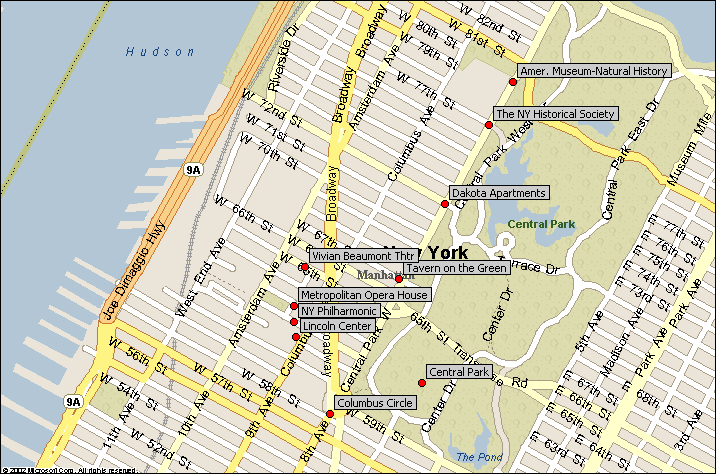
G and I had a long walk around the area last weekend. It is very attractive on a late summer day, and visibly more prosperous than it was ten years ago.A “fair share” law in the city charter requires social-services facilities to be evenly distributed through all neighborhoods, but West 94th and 95th Streets alone have seen half a dozen similar institutions proposed in recent years, from homeless shelters to drug-treatment centers to halfway houses. In 2008, Neighborhood in the Nineties released a study of data from the Supportive Housing Network confirming what the residents of the Upper West Side had long suspected: a full 21 percent of the supportive-housing units in Manhattan—1,978 units—were located on the Upper West Side. On the Upper East Side, by comparison, there were 93 units.
Monday, January 23, 2012
What makes the culture of the great cities different?
There's one other question which is raised by the Pinker quote just below. He says the more cosmopolitan, mobile, open regions are more inclined to impersonal exchange, and have shifted away from communitarian sharing or authority norms.
It gets me thinking about the great cosmopolitan cities - like New York. Why are they so attractive? And what has that to do with impersonal ties or liberal values that Pinker says they exemplify?
Are they more fluid and impersonal and transactional and atomistic? Yes, at least here in New York, or London or Toronto or LA. Of course, there may be vicious social hierarchies, from Ms Astor's Four Hundred through to the nightclub pecking order or the competitiveness of Wall St. But it is a plural hierarchy, with gaping holes. You pick your own greasy pole.
Is it the anonymous impersonal aspects we specifically seek when we move here? To be sure, many people hit the road to the big city because they want to leave behind the restrictions of small town life or community disapproval.
But I think it is mostly aspiration which makes people move. It is the attractive force, not the repellent force that makes people pack their bags and come. In some ways, it is like the old answer Mallory gave when he was asked why he wanted to climb Everest: "Because it's there."
Here in New York, G and I don't know our neighbors at all, apart from the people next door who we know by sight and say hello to the elevator. We don't particularly want to invest in knowing them or more extensive local ties.
We don't want a lot of social obligation or community involvement. We get home from work and we mostly just want to spend time together, after being around all sorts of others in a transaction-like way all day. We can spend our time mostly as we want after work.
But it isn't really anonymity which makes us want to live here. It's the energy and stimulation.
The city has few roots itself. There's little left of old New York, gone through fires and redevelopment and real estate speculation. It is a seething mobile mass of transition, full of every extreme - achievement, beauty, loneliness, love, greed.
New York is the cinematic dreamworld of childhood picture books and romance at the top of the Empire State and police chases under subway tracks and intrigue in skyscrapers. It is larger than life. It is a daily miracle of eight million people grinding together.
Yet it is also unequal and ruthless and cramped and noisy.
So let's step back and think about this trend from community to impersonal values. To what extent will the evolution of the economy mean the world ends up looking more (or at least feeling more) like New York? Do you get the radiant energy or just the split atoms?
Historically, after all, cities had to replenish their population from the countryside because they were so unhealthy. Ur and Nineveh and Tyre and Alexandria and Rome all fell.
Cities are fragile in long-term perspective. They go through periods of remarkable growth and creativity, and then they stagnate. Florence is beautiful in part because it has hardly grown since the quattrocento. It illuminated the world for fifty years, and then the light faded. The same could be said of turn of the 19th century Vienna.
There are different kinds of great city. The commercial city (Hellenistic Alexandria, Venice, Amsterdam, London, New York) is different from the imperial city or religious capital (Rome, Vienna, Moscow, Xi'an, Beijing) or industrial center (Cleveland, Manchester, Dusseldorf).
So it could also be an issue of the evolution of a kind of city, a great commercial capital rather than an aristocratic showpiece. Cities are not necessarily cosmopolitan or mobile at all. They can be closed fortresses or overgrown company towns.
Is it really just impersonal exchange which makes New York so exciting, though? Surely the excitement of the city is the sense that there is experience here which can't simply be bought in Peoria or Kansas City or a village back in Fujian Province. It is ambition, hope, dreams.
Is it freedom from we want here in New York, or freedom to, in Isaisah Berlin's old phrase?
Maybe that's the phase transition. We've had a century where we have - slowly and painfully - evolved institutions which deal with freedom from - want, hunger, violence, scarcity. But we haven't really begin to get our heads around the next stage, freedom to.
The trouble is in the past it has led to utopian disaster or chaos. Or a more militaristic, violent people swept in from the steppes or the hinterland or the empire and strangled the liveliness of the city. Or they just exhausted their vitality and went into decline.
It gets me thinking about the great cosmopolitan cities - like New York. Why are they so attractive? And what has that to do with impersonal ties or liberal values that Pinker says they exemplify?
Are they more fluid and impersonal and transactional and atomistic? Yes, at least here in New York, or London or Toronto or LA. Of course, there may be vicious social hierarchies, from Ms Astor's Four Hundred through to the nightclub pecking order or the competitiveness of Wall St. But it is a plural hierarchy, with gaping holes. You pick your own greasy pole.
Is it the anonymous impersonal aspects we specifically seek when we move here? To be sure, many people hit the road to the big city because they want to leave behind the restrictions of small town life or community disapproval.
But I think it is mostly aspiration which makes people move. It is the attractive force, not the repellent force that makes people pack their bags and come. In some ways, it is like the old answer Mallory gave when he was asked why he wanted to climb Everest: "Because it's there."
Here in New York, G and I don't know our neighbors at all, apart from the people next door who we know by sight and say hello to the elevator. We don't particularly want to invest in knowing them or more extensive local ties.
We don't want a lot of social obligation or community involvement. We get home from work and we mostly just want to spend time together, after being around all sorts of others in a transaction-like way all day. We can spend our time mostly as we want after work.
But it isn't really anonymity which makes us want to live here. It's the energy and stimulation.
The city has few roots itself. There's little left of old New York, gone through fires and redevelopment and real estate speculation. It is a seething mobile mass of transition, full of every extreme - achievement, beauty, loneliness, love, greed.
New York is the cinematic dreamworld of childhood picture books and romance at the top of the Empire State and police chases under subway tracks and intrigue in skyscrapers. It is larger than life. It is a daily miracle of eight million people grinding together.
Yet it is also unequal and ruthless and cramped and noisy.
So let's step back and think about this trend from community to impersonal values. To what extent will the evolution of the economy mean the world ends up looking more (or at least feeling more) like New York? Do you get the radiant energy or just the split atoms?
Historically, after all, cities had to replenish their population from the countryside because they were so unhealthy. Ur and Nineveh and Tyre and Alexandria and Rome all fell.
Cities are fragile in long-term perspective. They go through periods of remarkable growth and creativity, and then they stagnate. Florence is beautiful in part because it has hardly grown since the quattrocento. It illuminated the world for fifty years, and then the light faded. The same could be said of turn of the 19th century Vienna.
There are different kinds of great city. The commercial city (Hellenistic Alexandria, Venice, Amsterdam, London, New York) is different from the imperial city or religious capital (Rome, Vienna, Moscow, Xi'an, Beijing) or industrial center (Cleveland, Manchester, Dusseldorf).
So it could also be an issue of the evolution of a kind of city, a great commercial capital rather than an aristocratic showpiece. Cities are not necessarily cosmopolitan or mobile at all. They can be closed fortresses or overgrown company towns.
Is it really just impersonal exchange which makes New York so exciting, though? Surely the excitement of the city is the sense that there is experience here which can't simply be bought in Peoria or Kansas City or a village back in Fujian Province. It is ambition, hope, dreams.
Is it freedom from we want here in New York, or freedom to, in Isaisah Berlin's old phrase?
Maybe that's the phase transition. We've had a century where we have - slowly and painfully - evolved institutions which deal with freedom from - want, hunger, violence, scarcity. But we haven't really begin to get our heads around the next stage, freedom to.
The trouble is in the past it has led to utopian disaster or chaos. Or a more militaristic, violent people swept in from the steppes or the hinterland or the empire and strangled the liveliness of the city. Or they just exhausted their vitality and went into decline.
Tuesday, October 11, 2011
The step-off- the-plane test
I'm sitting here at JFK for an early morning flight. I still find it remarkable that you can sit on a plane for a few hours ..... and step off the jetway onto a different continent, into a completely different context. (G loves to tease me about feeling this way.)
But it is a routine miracle of daily life, beginning in the 1960s.
I'm heading for the west coast today.
Fifty years ago, that would have been a four day trip by rail. One hundred fifty years ago, it would have been six months around Cape Horn and the worst ocean storms in the world. Now I can complain about the airline pretzels instead while I watch the midwest roll by beneath my window.
I've been thinking about recent arguments that we have not seen much technological progress in the last three decades in daily life - with the huge exception of computers and the Internet.
This flight today will take just the same flight time as 1970, and counting in having to arrive earlier at the airport for security reasons the journey will actually take longer.
Of course, the ticketing and reservation systems have changed. Travel agents are mostly a memory. The pilots carry their charts in iPads. Efficiency has been upgraded in so many ways.
But economy class seats have not.
The availability and variety of products has grown enormously since 1970. Try finding arugula or szechuan peppercorns in a supermarket back then. We have three hundred channels on tv instead of three.
And perhaps we travel more frequently than we did. I was in this very terminal less than ten days ago going to Miami.
But if you look around at the streetscape of New York, it does not look as "advanced" to visitors as it did in 1970. Cities with a fraction of the income, like Shanghai, have a towering skyline. Dubai was pretty much a dusty fishing village in 1970 and now has its own array of glittering towers and overflowing malls.
How do we recognize a place is wealthy or advanced now, at first glance as we step off the plane?
Part of it is orderliness. The streets are clean, the subway works, the police aren't corrupt.
Part of it is aesthetic appeal. Wealth surrounds itself with beauty and culture. We were sitting in Bryant Park the other night at twilight and it was just lovely, as the light slowly faded on the surrounding buildings and the evening air was fresh. In second-tier places you get ugly concrete slabs and miles of bland or unimaginative housing.
Part of it is culture. I was at the Metropolitan Museum yesterday, that vast treasure house, and saw their exhibition on Indian Painting. (Worth seeing).
Part of it is education. New York has its world-class universities and intellectual fireworks.
But it is not as easy any more to tell how wealthy somewhere is just by stepping off the plane and looking for superhighways or a skyline.
Wednesday, October 5, 2011
Gratuitous Extra Photo of Miami

.
Art Deco Architecture on Ocean Drive, South Beach. In the 1980s South Beach was a crime-ridden run-down area, with dilapidated and outmoded buildings.
Now the beautifully restored 1930s architecture gives a young city a sense of place and history and character. People want beauty and a sense of something unique. And if you do it right, you get huge wealth in real estate.
Sunday, October 2, 2011
Flew into Miami Beach
I'm sitting here writing this on a balcony in Miami Beach. Just saying that brings a smile to my face. It is not even just the fact we are here, but the fact we CAN be here. We can choose to spontaneously go somewhere and do something different from normal routine, watching the shorebirds skim along the breaking surf below.
G and I suddenly decided on Monday evening earlier this week that we needed a break We had to get up at 5am yesterday to make an 8am flight from Kennedy, but three hours sitting on a Delta jet and here we are.
Miami is so attractive at first glance. Forests of pastel-colored skyscrapers, art deco architecture, and neon highlights. It has the palm trees and the ocean. A degree of culture too, a feel that Miami is slowly developing into a major world city.
We were out in South Beach last night. There is no sign of anything like recession or slowdown here, at least judging from all the crowds milling around and the full restaurants on Ocean Drive.
G said the atmosphere is like St Tropez, which is exactly right. Very beautiful, relaxed, quite wealthy.
But South Beach is no longer just a haven of models and the beautiful people, either. The procession of people passing by our outside table seemed very middle America, and mostly a bit overweight.
There is also something a little too hedonistic and shallow about it, perhaps. Or maybe that is just me thinking about what the epitome of South Beach local life is - the beach, parties, being seen at the right clubs, soft drugs, a suggestion of something harder-edged lurking in the other districts outside Lotus land.
We had very good food sitting outside at a restaurant on Ocean Drive, watching people pass by. I had a paella which was as good as any I had in Spain. The quality of food has leapt up around the western world in the last ten years. Many of those small details of life, the quality of daily experiences, are improving steadily. I'm drinking coffee from a Starbucks 'Via" packet, which is ten times better than usual hotel coffee.
What we choose to do on vacation tells us a lot about what we really want. Usually G and I charge around a place seeing every cultural attraction or national park within a few hours driving distance. That's what we did last time we were in this area, eight years ago. We did Everglades National Park, the Overseas Highway and Key West, Key Biscayne, Coral Gables and Miami Beach - all in about four days.
Yesterday we actually sat on a lounger on the beach for an hour. Very unlike us.
So what do most people come to Miami Beach for? The climate, of course, especially in midwinter. The deep subliminal attraction of the ocean, the beach, the surf, the waves crashing onshore. The good food and bright lights and parties - although I wonder how different that really is to most cities around North America on a Friday or Saturday night. It might have something to do with a feeling of membership, of being the kind of person with the tastes and sophistication to want to go to an "in" place. People are very good at self-grouping and clustering into cliques.
And there must be an independent attraction to variety and novelty, a chance to see somewhere new and do things differently to normal routine. I think that explains much of the reasons people jump on a plane for holiday. Although we also chose to come and stay in the same hotel we stayed at eight years ago. For nostalgic reasons, I suppose.
I'm very interested in what makes a city attractive and livable, why people choose to live in one place rather than another. I am not sure I'd want to live here. I don't know what we'd really do with a condo here, for example, although clearly many people do. And we are very happy with where we live in New York already.
But right now, sitting with a coffee on a balcony overlooking the ocean is perfect.
The sun is just rising, streaming from behind a cloud.
Sunday, September 4, 2011
Density and Vitality in Cities
Here's an interesting opinion piece in the NYT on how density in cities fosters growth, by giving niche or experimental businesses more chance to find an audience:
How great are the benefits of density?... Some economists have concluded that more than half the variation in output per worker across the United States can be explained by density alone; density explains more of the productivity gap across states than education levels or industry concentrations or tax policies.The problem, accruing to author Ryan Avent, s that residents of dense cities like San Francisco also limit building, to preserve neighborhoods, and that drastically forces up house prices. And that means skilled workers can't afford to move there, or leave for places like Phoenix with a much lower cost of living.Put two workers with similar skill levels in cities of different densities and the one in the denser place will be more productive, according to two decades’ worth of research from economists...
What is it exactly that dense cities are doing? Consider a simple example. Suppose that within a population one person in 100 develops a taste for Vietnamese cuisine, and suppose that a Vietnamese restaurant needs a customer base of 1,000 people to operate profitably. In a city of 10,000 residents, there aren’t enough people to support a Vietnamese restaurant. The only restaurants that can operate profitably are those appealing to considerably more than one in 100 people — restaurants offering less daring fare. In a city of 10,000 people, there is little room for specialization, and less for experimentation.A city of one million people, by contrast, can support multiple Vietnamese restaurants. Not only will this larger city enjoy a specialty cuisine unavailable in less populous places, but its ability to support multiple producers of this cuisine allows for competition, improving the price and quality.
Tuesday, August 2, 2011
The Endless variety in cities
My other half read the post about cities below, and as usual had something smart to say. It's about variety and specialization, she says. That's why people move to New York and places like it.
A lot of people are familiar with the old distinction (most familiar from Isaiah Berlin) between the fox and the hedgehog. Foxes know many things. Shakespeare was a fox, and so was Aristotle. Hedgehogs know one big thing very well - they are system builders. Dante was a hedgehog, and so was Plato. Most people lean towards being one or the other.
She says a fox likes the big city because there are so many different things to do - so many different things to try and dip in and out of. The sheer surprising multiplicity enhances life.
For a hedgehog, there are so many people and groups that there are endless opportunities to specialize in your one big thing. If you are into collecting antique buttons or contemporary flamenco, there will be something to engage your passion. So hedgehogs like it too, and ignore the variety.
Why spend so much to live in New York?
it is 88F and sunny. I am sitting in a park near the office on a glorious August afternoon. Relaxed people are dotted around, sitting in the shade and eating sandwiches and looking at the parade of New York City life. The tourists and the t-shirts and the suits and the squirrels all go by. I am ringed by trees and skyscrapers and the distant sound of taxis and music playing.
My other half was talking about the 'Medium Chill' article I posted the other day. The author deliberately chooses to live in a tumbledown house in a rougher area of Seattle, and does not feel the need to get more ambitious and acquisitive. It is not tuning out for him, it is not being countercultural. It is making a choice about what you value most. More time, less stuff.
It sounds good, marvellous in fact. We intrinsically have sympathy for the idea as a couple. it sounds all the better after vast consumer spending and debt binges have created economic disaster around the world. It is more environmentally sustainable as well, most likely.
But then again I write this on a park bench in Manhattan. We live in a nice apartment upscale part of town. There are few other places on earth more driven than New York. The rats run faster races here than anywhere else.
Why do we do it? What makes it worth it to live here? After all, we could have much more living space in most other places. We could have trees and grass of our own.
What is so compelling about living here then? We do love it. Every time I fly back to JFK, my heart still lifts when we round a curve on the Long Island Expressway coming into town and see the great forest of skyscrapers again.
But why shouldn't we downshift to a slower life somewhere quieter? We could manage it financially, to slow down and downshift significantly, work fewer hours. We could have just as many books and movies and art, and probably have time to enjoy them too.
We love being at the center of things, I suppose - where history is happening, where there is always something new, where you feel energized just by looking around. We love living next to the greatest art galleries, the wonderful concerts and opera and restaurants - although sometimes when we are tired we have to make an extra effort to go out and take advantage of them. Energy is in short supply on Saturday mornings after the week too. You need energy to take advantage of all the opportunities.
We evidently have an extra need for stimulation and experience. We are curious and love books and travel as well. We want to know things and experience things. It is our instinctive view of the good life.
We have often discussed as a couple the fact that experiences make you more happy than more money. So it makes sense we live where peak experiences crash in like ocean waves. New York is the capital of experience, gushing and cascading and flowing in great torrents. Tranquility would just seem to...slow, too much the same.
We like having good careers. We are well paid and successful, although we haven't been willing to make huge sacrifices of time and freedom to get to the very top.
But it isn't primarily the career at is the attraction to living here. Neither of us have changed jobs in a long time. In some ways in that sense we might be better off in Washington or Boston or London. We like to spend time together rather than more time in the office.
Why here? It is the connection, the networks and cross-fertilization - but most people in cities have their own circles and don't mix quite as much as urban theorists think.
It is the ability to walk to the Metropolitan Museum - but in some ways the most interesting art is not here in expensive Manhattan.
Maybe talking about the future of the economy is a bit like talking about different places to live. The world may evolve to become more like San Francisco is now - or Lagos. People used to believe the future happened in California first. Not so much any more.
There is such variety of lives just based on place: between New York and Barcelona's Eixample, houses on Oahu's North Shore, North Vancouver, medieval central Siena. Or rural Vancouver Island out towards Port Renfrew. Or upstate New York near the Andirondacks. Why do people choose to live where they do, and why do they choose to move?
A lot of it must be inertia. Some, particularly in older societies, is a sense of rootedness, of belonging to a community - which is not really a New York thing at all. Some of it is nostalgia, personal history and meaning in this place where we have lived much of our lives. Places are lived stories, our own stories and stages and props and poems.
Some of the limits are obviously about money - attractive places cost more to live, and can become prohibitive. But what makes attractive places? Everyone agrees Paris is more attractive than Cleveland, but after that there is plenty of room for disagreement.
Some of it is avoiding commuting, certainly for us. We don't want to spend three hours a day on I-95 and the Merritt Parkway, like some people we know.
You come to love the things that ARE good about where you are. We don't think about our small apartment, but do thrill at walking home in SoHo after an excellent meal. Still, the material circumstances are more and more similar over time. If you live in the country, you are glad to escape the noise and the lack of fresh air and crowds of the city.
We certainly yearn sometimes at this time of year for our own backyard and grill. but for today at least I can sit here in the park at lunchtime.
Until I have to go back inside to my desk.
How are cities and companies like ecologies?
Here's an interesting TED talk looking at the relationship between size and success of animals - and cities. There are advantages to scale, he says, but problems like crime also scale up as well.
He also talks about the sigma-shaped growth of companies. They tend to grow rapidly, level off for some time, and then almost without exception disappear and die as well. It is interesting stuff both from an evolutionary perspective and a returns to scale perspective.
He also talks about the sigma-shaped growth of companies. They tend to grow rapidly, level off for some time, and then almost without exception disappear and die as well. It is interesting stuff both from an evolutionary perspective and a returns to scale perspective.
Subscribe to:
Posts (Atom)