Showing posts with label International Relations. Show all posts

Sunday, May 5, 2013

Morality unhinged from Wisdom

Walter Russell Mead writes about the situation in Syria, as Samantha Power, who urged humanitarian interventions, leaves the Obama Administration:

As a general rule, sad to say, the good guys and the smart guys often play on different teams. For too many foreign policy humanitarians, it is more important to have good intentions than to understand the crooked and wicked ways of the world you want to change. This instinct for the ideal over the real was a hallmark of humanitarian policy failures all during the 20th century and on the evidence to date the deadly mixture of political amateurism with ambitious humanitarian international agendas has persisted into the 21st. America’s university campuses are packed with people who believe that the flaws in our foreign policy are failures of morality rather than failures of forethought and execution, but morality unhinged from wisdom is one of the most destructive forces known to man.


Friday, November 9, 2012

Pakistan slowly melts

Meanwhile, grim signs in Pakistan. A family spent thirty years building one of the best girls schools in Lahore. The son of the family,a teacher in his thirties, was particlarly passionate about talking to many groups about astronomy.

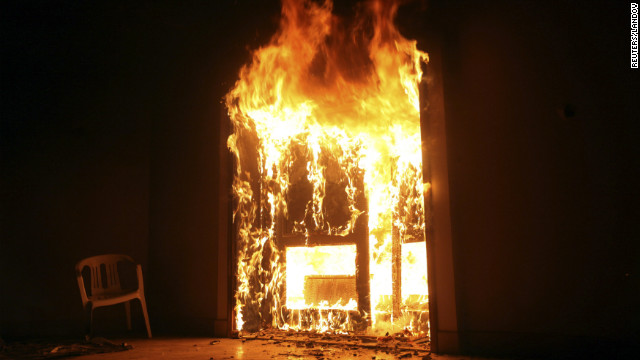
But on 31 October the school was burned to the ground by a crowd who had heard it was accused of blasphemy. Lab equipment and computers were looted. Hundreds of library books – obviously with little use to the mob – tossed into the fire. Some even tried to pull the marble tiles off the floor

A teacher had inadvertently missed a page while photocopying, linking a sentence about the Prophet Mohammed to a chapter on begging.

This blasphemy law is devouring Pakistani society from within. It is an all-purpose tool in the service of intolerance. It has often been used against religious minorities, but Muslims are paying the price as well. The repeal of the law, unfortunately, is unlikely. Some voices critical of the law have already been silenced by intimidation and violence, such as the assassination of the governor of Punjab, Salmaan Taseer in 2011.

What a terrible story. A country of 190 million is slowly sliding into a civilizational abyss. I was in Islamabad, Rawalpindi and some of the northern areas about fifteen years ago, and even then travel to Karachi or even main roads toward the south was not advised.

The Islamist methods used against the west, such as suicide bombings and oversensitivity, are now having their worst effects at home.

Monday, November 5, 2012

International Legitimacy and the American election

There's one other thing I should say, particularly to foreign friends who may read this blog. I noted just how astonishingly lopsided the view of the election is in many other parts of the world, especially Europe. 97% of Germans would vote for Obama. In any other context you'd think this was a made-up party number from the old East Germany. How can we explain why a country with a conservative government which is getting tough with Greece can be so one-sided in its view of the GOP in the US? The same applies in most other European countries.

Europeans detested George W. Bush too, far more than can be explained by his general political stance. Bush, after all, was actually more in the Nixon mode in domestic policy terms, rather than particularly right-wing. He ran massive deficits and spending, drove through new entitlements like prescription drugs, argued for loose immigration policy with amnesty, and nation-building efforts abroad. He cut taxes, but so do many EU governments from time to time. W claimed to be a "compassionate" conservative. He was relatively left-wing in many senses.

But millions turned out to march against Bush in Europe. "US foreign policy" post 9-11 is the reason, perhaps, but Obama has surged in Afghanistan, killed Bin Laden and stepped up drone attacks.

So what is going on here? I think there is a much deeper split about the nature of international legitimacy, a rift that started with the Yugoslavian war and has only grown since with Iraq. Europe has been committed to multilateralism and pooling of sovereignty for over fifty years now. European elites believe that legitimacy flows down from international law, including human rights law and the United Nations.

So as an example, the response to the euro crisis has been an unending series of multilateral, indecisive and testy summits. The whole motivating force of the European project was to suppress individual national tendencies which could produce war.

This view is (mostly) alien to the United States, where the US constitution is almost four times older than the UN and infinitely more venerated. Legitimacy flows up from the people. The UN and international institutions have little legitimacy, and there is little domestic support for tying national freedom of action. America ( to generalize) sees no advantage in subjecting its actions to the multilateral approval of Europeans, who refuse to bear the burdens or responsibility of actions or defense spending in any case.

So on the one side, Europeans see the GOP as a horrifying cowboy-like entity which violates the most basic elements of international legitimacy. And on the other, America, especially the GOP, sees Europe as fractious, irresponsible and naive, playing internal parlor games while America has underwritten the defense needs and spending which allowed the Europeans the scope to play their children's games in the first place. America deals with China and contains Iran while the Europeans squabble amongat themselves and shout abuse offstage.

It isn't a dispute about left versus right that produces 96% or 97% support for Obama in Europe, so much as a perception he will be more sympathetic to and bound by multilateral norms which give Europe a significant veto over US actions. Romney and the GOP seem like a crazed bull which will stomp all over their most deeply cherished notions.

In fact, if there is one thing that can lead to massive wars, it is profound differences about legitimacy ( see Philip Bobitt's , The Shield of Achilles: War, Peace, and the Course of History). Of course, that is hardly likely to happen here. But it does help explain some of the depth of feeling.

I don't have much sympathy with the European view, which naturally is self-interested in seeking restraints over US actions. We do need international institutions and flexible international law. But it cannot be wholly divorced from power or reality either.

Europeans over-read the lessons of 1945 in their own terms, as delegitimizing national institutions. America does not, and reads the Second World War as much about crazy European political excess and varieties of murderous Utopianism. And we have multilateral utopian excess today.

The differences may narrow again in the future, as the multilateral European project itself is under such strain. Euroskepticism is rampant in the UK, with talk of a referendum on EU membership. Dormant nationalisms like that of Catalonia are reigniting. The EU institutions have if anything negative legitimacy in Greece.

And even Obama, who is venerated so much in Europe, has initiated a "pivot to Asia."

Multilateralism is a wonderful dream, but Europe is prone to utopian overreach. And multilateral commitments are fragile, and sometimes utterly counterproductive. (Take the Kellogg-Briand Pact, which outlawed war, as an example. Just eleven years later the worst war in history began when Hitler invaded Poland).

Those poll numbers against Romney are more a symptom of a European fever about legitimacy than an accurate read on choices in America.


Thursday, October 25, 2012

Good intentions and catastrophic outcomes

Here's a great essay by Walter Russel Mead on the troubles of Obama's home state, Illinois, as well as California and New York. These states are the greatest fortresses of Democratic power in the country. But they are becoming fiscal catastrophes, undermining the support for the poor and disadvantaged that politicians had championed.

American liberalism today is in an advanced stage of intellectual decline. Cynical and short sighted interests wrap themselves in the increasingly tattered mantles of sacred ideas. Liberals are right to feel that social justice matters, that the poor should have greater opportunity and that government in a democratic society cannot remain indifferent to the existence of great social evils.

But where liberals in America have the freest hand—in states like New York, California and Illinois—we see incontrovertible evidence that the policies they choose don’t have the consequences they predict. California by now should surely be an educational, environmental and social utopia. New York should be a wonder of glorious liberal governance. Illinois should be known far and wide as the state that works.

Just like Europe, which is also clearly in trouble, massive debt and busted pension promises are the result. Good intentions are not enough.

Incidentally, Gallup polls suggest if Europeans had a vote in the US Presidential election, 96% of Irish and 97% of Germans would support Obama. Extraordinary.


Tuesday, October 16, 2012

China: Express Line to Corruption

This story in the New Yorker about corruption in the Chinese Railway Ministry is well worth a read. You might think that sounds like something which would only be of interest to obscure auditors. It is not. This is on a spectacular scale, truly dramatic, epic in its lurid dirt and crime, and it is the biggest example of something which is the biggest threat to political stability in China.

Other government agencies also had serious financial problems—out of fifty, auditors found problems with forty-nine—but the scale of plunder in the railway world was in a class by itself. Liao Ran, an Asia specialist at Transparency International, told the International Herald Tribune that China’s high-speed railway was shaping up to be “the biggest single financial scandal not just in China, but perhaps in the world.”

It is the (literally) concrete details which illuminate how life is changing for quarter of the world's population. It would make a movie which would make The Godfather seem tame.


Wednesday, September 26, 2012

Spring frost in the Middle East

There have been signs of frustration with the Islamists in the Middle East, including attacks on them in Benghazi. That is encouraging. But is it durable? Tom Friedman writes in the NYT:

It is not clear whether this trend can spread or be sustained. But having decried the voices of intolerance that so often intimidate everyone in that region, I find it heartening to see Libyans carrying signs like “We want justice for Chris” and “No more Al Qaeda” — and demanding that armed militias disband. This coincides with some brutally honest articles in the Arab/Muslim press — in response to rioting triggered by the idiotic YouTube video insulting the Prophet Muhammad — that are not the usual “What is wrong with America?” but, rather, “What is wrong with us, and how do we fix it?”
It isn't as if there are not some more sensible voices in the Middle East or writing in Arabic. The trouble is some Westerners persist in seeing them as the "vast majority". So we got lots of stories about the twitter revolution in Tahrir Square, but we ended up with the Muslim Brotherhood in power in Egypt and assaults on US embassies.

Yes, there are occasional voices of internal self-criticism in the Middle East. The Arab Human Development report pointing out the stagnation in Arab societies created a huge stir, too, but it was ten years ago. Nothing has fundamentally changed since, despite the Arab Spring. Indeed, the feverish hatred surrounding "blasphemy" shows if anything intellectual life is shutting down.

The fact is that in most Arab countries the extremists are the vast majority, despite the equally extreme efforts by Western liberals to avoid noticing the fact. Democracy entails Islamism, which has been the heart of the problem for decades.

Indeed, the whole rhetoric of "extremist" and "moderate" is suspect, as "moderates" are often repugnant as well. We get manipulated into supporting one faction against another local faction. Mubarak argued he would hold back the Islamists. So we put American money behind kleptocratic narcissism. The "moderates" are often just nasserites with different Swiss bank accounts.

Our patience with the Middle East needs to run out. Change will come. But we cannot bring it, and it could take centuries.

We need to contain Islam in the meantime. Engagement has led nowhere. So treat it like we treated communism. And treat those who scream "islamophobia" with contempt. It's like screaming "stalinophobia" in the 1950s. It's brainless and bigoted and stupid. The screamers need to be excluded.

For Arab Spring, read Prague Spring in 1968.

For the "islamophobia" screamers, read the communist stooges and Red Brigades and Maoists and fellow travelers of the 1950s and 1960s. And remember the fashionable leftist intellectuals who have never been held accountable for their collaboration with genocide and prison camps and sympathy for "struggle".

For the doomed Soviet economy in the 1960s, read the lazy Salafist regimes of the Gulf, living on borrowed time on oil reserves.

There are differences, of course. The Soviets had some technological ability. The Islamic states don't.

Sometimes the only way to deal with bad ideas is to let them fail. And let them know the only way they will get respect is if they earn it.


Friday, September 21, 2012

Obama's Foreign Policy Failures

Obama's foreign policy approach is looking deeply naive. Here's a deeply reported piece on his China policy in the NYT, which clearly relies on discussions with the White House. It claims he is shifting to a tougher line with China, after initial accommodation delivered poor results:

The shift emerged in fits and starts, after a first year in which critics, including the president’s aides, concluded that the United States had been too soft on China. In interviews, a dozen current and former administration officials described a White House that struggled to find the right tone with Beijing.

From his decision not to meet with the Dalai Lama in 2009 to his tightly constrained first trip to China, the president accommodated Chinese leaders in the hopes that the moves would translate into good will on issues like climate change or Iran’s nuclear program.

They did not. China spurned the United States on climate change standards, dragged its feet on efforts to pressure Iran and began bullying its neighbors over territorial claims in the South China Sea. That last development, in particular, persuaded the administration that the time for accommodation had come to an end.

The same story has played out with Iran.

To some extent, Mr. Obama’s learning curve on China parallels his early outreach to Iran: an initial hope that old adversaries could put aside their differences, followed by a jolting recognition of reality and the ultimate adoption of a realpolitik approach. The difference, officials argue, is that in this case the tougher line has led not to stalemate but to a constructive give-and-take with a country bound to rub up against the United States.

(My bold). Wishful thinking, in other words, was the basis of his foreign policy, and all the more so in his notorious Cairo speech. This is a deeply shocking account. A President is not there to have a "jolting recognition of reality" halfway through his term. That is shameful.

Charles Krauthammer is no friend to the Obama administration, of course. Still, his blistering attack in the Washington Post this morning makes sense. He says it is a foreign policy in "epic collapse."

It’s now three years since the Cairo speech. Look around. The Islamic world is convulsed with an explosion of anti-Americanism. From Tunisia to Lebanon, American schools, businesses and diplomatic facilities set ablaze. A U.S. ambassador and three others murdered in Benghazi. The black flag of Salafism, of which al-Qaeda is a prominent element, raised over our embassies in Tunisia, Egypt, Yemen and Sudan.
The administration, staggered and confused, blames it all on a 14-minute trailer for a film no one has seen and may not even exist.

What else can it say? Admit that its doctrinal premises were supremely naive and its policies deeply corrosive to American influence?

In foreign policy terms, I'm not a complete "realist", as the doctrine goes. Not everything is pure power or narrowly defined national interest. Legitimacy and ideas count as well. But you do have to deal with reality as you find it.

Much liberal foreign (and domestic) policy has a Hogwarts quality about it. It imagines that saying the right words can work like a magic spell, if only they are spoken in the right way. Perhaps that is a very old conviction about ritual that dates back to the earliest religions. But unfortunately the world does not respond to magic.


Monday, September 17, 2012

Blasphemy and trade-offs

Constitutional scholar Eugene Volokh, who heads up the Volokh Conspiracy blog, writes that attempting to clamp down on speech which Muslims find offensive is actually more dangerous than holding the line:

I think there are many reasons to resist such calls, but in this post I want to focus on one: I think such suppression would likely lead to more riots and more deaths, not less. Here’s why.

Behavior that gets rewarded, gets repeated. (Relatedly, “once you have paid him the Dane-geld, you never get rid of the Dane.”) Say that the murders in Libya lead us to pass a law banning some kinds of speech that Muslims find offensive or blasphemous, or reinterpreting our First Amendment rules to make it possible to punish such speech under some existing law.

What then will extremist Muslims see? They killed several Americans (maybe itself a plus from their view). In exchange, they’ve gotten America to submit to their will. And on top of that, they’ve gotten back at blasphemers, and deter future blasphemy. A triple victory.


I've been thinking a little more about the riots. There is an instance here of a more general problem: often the right course of action requires more sacrifice or even makes things worse on some measures in the short term.

For example, saving money makes you less well off now in consumption terms, but better off in the long run. When FDR and Congress declared war on imperial Japan in the wake of Pearl Harbor, it made things much worse on a short-term perspective, as any Marine on the beach at Iwo Jima could testify.

People are often very bad at making trade-offs in time or discounting the future. Still, the right answer to this problem is not necessarily the one that calms frenzied Islamic mobs in the short term.

Yes, responsible leaders ought to try to damp down short-term emotions. But then they also need to think rationally about the situation, rather than engage in wishful thinking.

Much of the problem in the Middle East is inherent conflicts are avoided or kept simmering without resolution. Volokh cites Pew research which finds more than three-quarters of Egyptian Muslims support the death penalty for apostasy, I.e leaving the Muslim religion. The Arab Street is deeply hostile to and profoundly at odds with our way of life. It is possible to try to damp things down too much.

There is little upside to compromsing our own principles to try to buy favor with Islamic mobs. If it is not a stupid video today, it will be rioting for the return of Al-Andalus to Islam tomorrow.

Friday, September 14, 2012

Clashes and riots

Walter Russell Mead, in a civilized and wise essay:

The person who comes out of all this looking smartest is Samuel Huntington. His book on the “clash of civilizations” was widely and unfairly trashed as predicting an inevitable conflict between Islam and the west, and he was also accused of ‘demonizing’ Islam. That’s not what I get from his book. As I understand it, Huntington’s core thesis was that while good relations between countries and people with roots in different civilizations are possible and ought to be promoted, civilizational fault lines often lead to misunderstandings and tensions that can (not must, but can) lead to violence and when conflicts do occur, civilizational differences can make those conflicts worse.

The biggest potential danger is potentially a massive breakdown in relations between Copts and Muslims in Egypt.

Unfortunately, Islamic radicals are deliberately hoping to promote a clash of civilizations in the belief that a climate of polarization will strengthen their political power in the world of Islam. Attacking the embassy in Cairo is an effort to push Egyptian opinion in a more radical direction, but the radicals hope that this is part of a larger push that will bring them to power across the Islamic world. Like Boko Haram in Nigeria, which hopes to provoke a religious war with the Christians partly in order to achieve power in the Muslim North, radicals use the prospect of a clash of civilizations to further their own cause throughout the troubled Islamic world.


Burning up the page

A remarkable series of 36 photos of the Islamic protests on the Atlantic website.


Islamic attacks spread

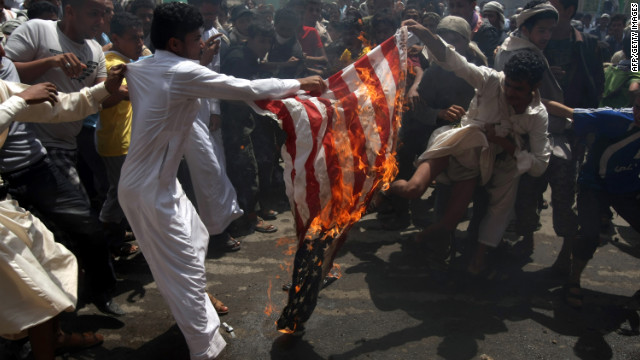
Islamic protests have now spread to twelve countries, says the NYT. The British and German embassies have been attacked in Sudan, and there is trouble in Tunisia, Algeria, Yemen, Gaza, Iraq and Bangladesh, among others: even lockdowns at colleges in North Dakota on bomb scares.

Is it in part just extremists being willingly provoked by other extremists, a game which seldom plays out well? Perhaps in part. Some Arabs evidently suspect it is a way for Salafists and others to throw countries into a religious frenzy at the expense of secular forces.
 
But it is still a horrific picture of crazed excess. The Economist chooses this inopportune moment to call for more engagement for the US in the Arab world, not less: the opposite of what i was calling for.

On the campaign trail Mitt Romney has been clobbering Barack Obama for being too keen on the Arab awakening. Many conservative Americans associate it with hostile Islamists, like the Muslim Brothers and their friends who now run Egypt and Tunisia, and see it as a threat to America’s ally, Israel. Americans of all sorts are nervous about being dragged into Syria and worried about Iran getting the bomb. They are fed up with being described as anti-Islam when their country is in fact far more welcoming to Shia Muslims than, say, Sunni Saudi Arabia is. With their troops now mercifully out of Iraq, their efforts to push the Israeli-Palestinian peace process going nowhere and shale gas reducing their dependence on Arab oil, surely it is time for them to leave the world’s least grateful people to make a mess of their lives by themselves?

This is a seductive narrative—and no doubt it will play even better on the campaign trail after Mr Stevens’s death (see Lexington). But it is deeply wrong in both its analysis and its conclusions. Many parts of the Arab world are in fact heading in the right direction. And in the parts that are not, notably Syria, the United States is more needed than ever.
America has spent a trillion dollars and thousands of lives trying to nation-build in the Muslim world in the last decade. The optimistic Bush view that all Arabs needed was to be freed from tyrants looks ever less realistic.

It is insane to imagine America getting involved in Syria, at least on any terms of engagement "international opinion" would accept which would entail US troops being allowed to adequately defend themselves.

America needs to disengage or destroy, not nation-build for those who do not want it. And the US is rarely if ever cruel enough to destroy, like Tokyo or Berlin in the Second World War. So that logically leaves disengagement.


Liberal media meltdown

The reaction in the media to Romney's criticism of the administration on Egypt and Libya is almost enough to make Romney look good. I haven't been impressed by Romney. But the prejudiced reaction by much of the press - to turn something which genuinely does call into question the whole Obama approach to the Middle East into a "Romney gaffe" - is just astonishing.

Here's an example in a muddled and confused NYT column. It rightfully praises the assasinated US ambassador to Libya. But it attacks the "visceral hatred" of Islam in parts of the United States.

The Obama administration never expressed sympathy for the assailants. It never apologized for American values. What the Cairo embassy did, as violence brewed in the Egyptian capital and well before the Benghazi attack, was to condemn “actions by those who abuse the universal right of free speech to hurt the religious beliefs of others” — specifically Muslims.

Since when was extreme bigotry that portrays the followers of one of the world’s great religions as child molesters an American value? Religious tolerance is as fundamental an American value as free speech. For Romney to offer implicit defense of a scurrilous movie in the name of free speech, while misrepresenting the Obama administration’s actions and offering not a word about hatred toward the world’s more than 1.5 billion Muslims, suggests he is deluded or desperate or both.

The same liberal media has only been too happy to portray the Catholic church as mostly made up of molesting priests. You could have read much of the Democratic National Convention as "hurting the religious feelings" of anti-abortionists or people who wanted God mentioned in the party platform. Last week G and I were offended by Madonna's latest concert tour, which received a positive review in the NYT, which did not consider whether it would "hurt the religious feelings of others."

There is a deep hypocrisy here. Apparently only the hurt religious beliefs of those who riot and kill matter. And that's the problem, and why Obama got it wrong.

Americans have been remarkably tolerant of thirty years of attacks from Muslims claiming to act in the name of Islam. No Muslim ambassadors were attacked after three thousand Americans died on 9/11. It would have been unthinkable.

The issue is one of thresholds. It clearly sounds as if the offending video in question has no redeeming merits. But the kind of multicultural tolerance Roger Cohen has in mind here only runs one way. America does not erupt in riots when the American flag is burnt in Egypt. It would be ridiculous.

This September surprise has given the world cause to appreciate the cool head in the White House and worry about the hothead who aspires to replace him. Romney, in Jacques Chirac’s immortal phrase, “lost a good opportunity to keep quiet.”

If Romney' first instinct is to think of American interests instead of the dignity of Islam, that's a good thing - hard-headed as opposed to soft-in-the-head. Appeasement is not cool-headed. It invites further violence.

Think about it. Romney is a "hothead" for raising legitimate questions about US foreign policy, but storming embassies and threatening Christian minorities should be overlooked? The issue is the people whose religious feelings are "hurt" are clearly the hotheads. Refusing to recognize that does not help.

I think what this shows is irrational panic in the media about the other "narrative" in this situation - the long shadow of Jimmy Carter.

Or perhaps it shows there is hard-wired incomprehension of the situation. The instinctive liberal response is to fail to see anything except issues of fairness towards Muslims. They simply cannot see anything beyond that. Liberals simply don't understand they are part of a very small subculture, which is why the left has done so badly in the midst of the worst economic crisis in seventy years. Far from understanding other peoples' point of view, they are unaware alternative viewpoints even exist, outside of the various slurs they hurl. Articles like this one come across as pompous, self-righteous and utterly out of touch.

As I said below, the right response here is not more praise for Islam from the United States, but containment and disengagement. If you meet a crazy drunk in the subway, the right response is to move away, not walk up and give speeches about your great respect and tolerance for his preferred brand of liquor.

What Obama should have said is: the same openness and tolerance which protected Muslims in the United States from riots and attacks and internment after 9/11 is the same openness which allows people in the US to disrespect Islam, too. And we make no apology for that.


Wednesday, September 12, 2012

Repugnant anti-American violence on 9/11

I am furious about the attacks on our embassies in Libya and Cairo. Islamic mobs marked the anniversary of 9/11 with bigoted violence and killings of diplomats.

The appeasement reflex of our embassy in Cairo, condemning those who "hurt the religious feelings of others" more than the perpetrators, is also shameful.

Victor David Hanson writes on the National Review blog:

Obama’s effort to appease Islam is an utter failure, as we see in various polls that show no change in anti-American attitudes in the Middle East — despite the president’s initial al Arabiya interview (“We sometimes make mistakes. We have not been perfect.”); the rantings of National Intelligence Director James Clapper (e.g., “The term ‘Muslim Brotherhood’ . . . is an umbrella term for a variety of movements, in the case of Egypt, a very heterogeneous group, largely secular, which has eschewed violence and has decried al-Qaeda as a perversion of Islam.”); and the absurdities of our NASA director (“When I became the NASA administrator . . . perhaps foremost, he [President Obama] wanted me to find a way to reach out to the Muslim world and engage much more with dominantly Muslim nations to help them feel good about their historic contribution to science.”) — to cite only a few examples from many.

At some point, someone in the administration is going to fathom that the more one seeks to appease radical Islam, the more the latter despises the appeaser.

Wishful thinking is not a substitute for policy. The "vast majority" of the Arab street is deeply hostile, and pretending otherwise is stupid.

A first step would be to make sure anyone who thinks killing people is a justified response to an "insult to the prophet" by some obscure nobody somewhere in the US never gets a US visa and never sets foot in the United States, nor anyone who makes excuses for them. We expect people to resist provocations without killing innocent parties. It should be a required test on every US visa application: "Have you ever participated in or verbally supported killing people or rioting in response to alleged insults to religious figures." Automatic denial.

This kind of zealotry and fanaticism is not acceptable. There needs to be more of a containment model in our dealings with the Islamic world, on the model of the Kennan approach to the Soviet Union. We did not endlessly praise the wonders and peacefulness of communism during the cold war, after all. We did not think the path to peace was endless recitation of the enlightenment of Marxism-Leninism. Quite the opposite. We refused to give it ideological legitimacy.

We need more separation, rather than more engagement or attempts at suasion. And we need to argue for our own values rather than ignore problems in the hope they will go away.


Tuesday, September 4, 2012

Spanish bank trot continues

The NYT has a very vivid piece on deepeing anxiety in Spain. Spaniards continue to pull their cash out of banks at a "trot", even if it is not a full bank run for now. Deposits equivalent to 7% of GDP were withdrawn in July. And the educated classes are starting to look abroad. They are opening accounts in London and even moving there.

According to official statistics, 30,000 Spaniards registered to work in Britain in the last year, and analysts say that this figure would be many multiples higher if workers without documents were counted. That is a 25 percent increase from a year earlier.

One fascinating reason is there is a fear of what happened in Argentina:

The corralito, or corral, as the Argentine action is known, has become part of the public conversation in Spain. The million-plus Argentines who have since immigrated to Spain have provided ample and gory stories of desperate legal battles and wiped-out savings.

That's remarkable. Many people will personally know someone who lost everything in a currency crisis.

Even ECB bond purchases may now only buy time. They would not solve the growth problem, and after the initial relief wore off problems of inflation fears and fiscal resistance would be much worse. And if Germany does get more EU control over member budgets , what happens when Paris is blocked by strike action or roads get blocked in Italy? Local sovereignty, accountability and legitimacy will be gone. If you think the EU s unpopular now, just wait.

The European elites so desperately need something this September I suspect they'll get another deal whih will rally markets. For a while. But there is no obvious way out.

Monday, September 3, 2012

America's campaigns and Europe's catastrophe

Here's two superb essays in quick succession by Walter Russell Mead, in the space of a day or two. First, a condemnation of lazy media overage of American politics. Political strategy has become far more sophisticated and data driven in the last ten years, he says:

The legacy media is too stupid and too lazy to understand the event on which it expends more resources than any other — and as long as enough eyeballs are attracted by the show, it doesn’t really care.

This is not a conspiracy and it is not the result of bias; it’s not clear whether reporting the real plans and calculations of the strategist would make either or both sides look better or worse. But it should underline the point that what the “news” industry labors to produce during presidential campaigns is infotainment pure and simple. There is no competitive pressure to unearth the actual dynamics of the campaign strategies of either side, only a pressure to score with gotcha and gaffe scoops or otherwise to present the reality of entertainment clothed in the appearance of actual news.

And he follows up with a very good essay on the Eurozone:

Have we all been underestimating the gravity of the European crisis? That deeply unsettling question threatens to wreck the world’s peace of mind in what could just be a much more turbulent fall than people expect. The American election and much else could be wrenched out of shape by new and much more dangerous developments in the world’s worst man-made policy disaster of the last generation.

Europe is in a bind:

Most leaders agree that Europe’s problems can’t be solved without some big institutional changes, but that will require some referendums. Nobody wants to take European questions to the voters right now because fed up voters in many countries are itching for a chance to say no.

In other words, Europe can’t work without changes it can’t make.

Just superb stuff, albeit unsettling. The man is just off a plane from India and produces more insight than whole journalistic and academic armies put together.


Tuesday, July 3, 2012

Two fascinating energy stories

Here's two fabulous posts about energy in short succession on Via Meadia, both of which came as news to me.

  • India's great power potential could be undermined by growing energy shortages. Geopolitical power could be diminished by a lack of actual electrical power. The government subsidizes kerosene, gasoline and other basic necessities, and is reluctant to change that because of the potential destabilizing effect on the poor. But it also means there is little or no incentive to grow capacity.
  • In contrast, Israel is suddenly turning into a potential energy power. It has potentially vast shale oil and gas reserves. (I had to google this in other places before I believed it.) There are already some geopolitical consequences, with Russia and India showing interest in cooperation with the Israelis. The Gulf Arabs may have much less clout abroad.
 

Sunday, June 24, 2012

Political Scientists are Lousy Forecasters

So says this NYT article by a political science professor at Northwestern who is not going to be very popular at the next faculty meeting.

It’s an open secret in my discipline: in terms of accurate political predictions (the field’s benchmark for what counts as science), my colleagues have failed spectacularly and wasted colossal amounts of time and money. .... Many of today’s peer-reviewed studies offer trivial confirmations of the obvious and policy documents filled with egregious, dangerous errors.
 

Part of the problem may be the government tends to disproportionately fund statistical research, she says. But now Republicans want to defund political science grants from the National Science Foundation.


The bill incited a national conversation about a subject that has troubled me for decades: the government — disproportionately — supports research that is amenable to statistical analyses and models even though everyone knows the clean equations mask messy realities that contrived data sets and assumptions don’t, and can’t, capture.


The two problems are linked. There are inherent limits to forecasting, but you only compound errors if you insist on throwing out most of the relevant qualitative evidence before you start. Any serious analysis has to have some historical awareness, for a start.

Monday, April 23, 2012

Democracy and the importance of Legitimacy

I read Democracy: A Historyby John Dunn, who is Professor of Political Philosophy in Cambridge. He traces how the word "democracy" has been used historically since its beginnings in classical Athens. Of course, we think of it as the fundamental legitimizing principle for states today.

But the irony is "democracy" was mostly used as a term of condemnation and an example of chaos and failure for two thousand years, right into the late eighteenth century.

And now it also means something almost entirely different from its original meaning of the citizens of Athens direcly ruling themselves. There is a "chasm", Dunn says, between that and our modern representative democracies.

Indeed, it was Robespierre more than anyone else who brought the term back into circulation, and the left wing of the French revolution such as Babeuf who wanted it to mean equality.

Democracy has altered its meaning so sharply since Babeuf because it has passed definitively from the hands of the Equals to those of the political order of egoism.

By egoism Dunn means the modern self-interested capitalist world of Alexander Hamilton and the Manchester Liberals. In the second world war and cold war, however, that was a thin basis for loyalty. In the fight against fascism and communism, western leaders needed something more - a renewed stress on democracy as an ideal.

In the last instance, and in the face of intense suffering, they needed it above all to focus their citizens' allegiance, and to define a cause worth fighting to the death for in a way that the order of egoism could never hope to provide for a good many.

And the horrors of revolution from Mao to North Korea to the Khmer Rouge elimated other serious competitors for forms of state and principles of legitimacy.

In these later episodes, in all their desolation, the rage for equality becomes for a time something very close to a rage against the reality of other human beings or the very idea of a society.

And in the meantime democracy as a value undermines most other claims to power or privilege, as Obama or Cameron or Merkel know.

It dissolves the pretensions of intellectuals and corrodes the claims to authority of all who happen at the time to exercise political authority anywhere in particular.

It is an observant and trenchant book. What stays with me, though, and which is relevant to this blog project, is a renewed focus on the basis of legitimacy. Why do we see current arrangements as legitimate? In large part because that 'egoist' self-interest capitalist framework has delivered.

In order to durably shift the nature of the economy, however, the basis of legitimacy would likely have to shift again. And that is a difficult and dangerous matter.

It reminds me of Phillip Bobbit's book The Shield of Achilles, which traces the history of the states system over the last five hundred years. He sees it as a story of successive principles of legitimacy - and therefore forms of state - evolving with epochal wars dividing them. He sees the "market state" as the culmination of that process in our own time.

But if, as I think, we are reaching the limits of the market as a device which can underpin the economy, then that spells potential trouble. As always, it is not because there is anything wrong with the market. It is just that it is a tool which cannot accomplish all our human purposes if we largely have material abundance and the nature of our needs starts to shift.

So this suggests more room for blogging on legitimacy and the potential for disorder if we are seeing a phase shift in the nature of the economy and the state.