Saturday, November 3, 2012

Loneliness and Marriage

This column in the UK Telegraph notes there has been a huge increase in the number of people living alone. It isn't just more single young people, either.

As the ONS makes clear, the largest increase in solitary living is down to the 45-64 age group. Almost two and a half million Britons in that age category have no one with whom to share their home, an increase of more than 800,000 households since the mid-Nineties. Even allowing for the increase in total population size, that’s still a noticeable change, and they don’t all enjoy the experience.

In US terms, that would be an increase of around four million people living alone. Many might choose it, of course. Many more would not.

Much of this blog is about what leads to actual happiness or flourishing, rather than simply measuring welfare as GDP or material standards of living. And this is a sign of social deterioration. Loneliness is not part of flourishing, and it deserves far more attention than it gets in general public discussion. Gross National Loneliness is as important as GDP once you have a threshold of acceptable material living standards, as I've argued before.

Marriage, the author argues here, is the most important bulwark against loneliness, and the government should promote it.

Michael Howard deployed a powerful phrase in defence of his criminal justice policy: prison works. It’s time we used a similar phrase, in defence of social justice: marriage “works” too. It works for most people and definitely for civic society, yet we find it hard to say this, and shy away from its political implications. What started as a desire not to judge “lifestyle choices” has bred a generation living in lonely, quiet despair. Loneliness is a much harder political issue to tackle than, say, house-building, but – if we believe in “society” at all – hardly one of lesser significance.

Socially conservative? Yes. But then it's often the most vulnerable who are left worst off by declining social ties. More choice for some often has consequences. A libertarian or highly liberal approach to relationships and families leaves a lot of shattered lives. Liberal neutrality often produces meaninglessness and emptiness.


What a week: Sandy blows down certainties

It's only now, on Saturday morning, that I can think about blogs rather than hurricanes.

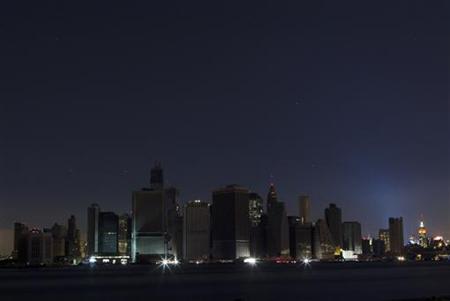
G and I have been comparatively lucky. Our windows rattled a little but the direct impact of the storm on the area immediately around us was not too bad. We lost power in midtown Manhattan around 8pm on Monday. We just stayed in the next day, rather than walk down many, many flights of stairs (and back up, of course) while wind advisories were still in force outside. Manhattan is filled with sidewalk sheds and scaffolding that you don't want to be under in high winds.

The loss of electricity itself was not a major blow. We ran our iPhones and iPads a few minutes an hour, and that prolonged the batteries. We could read by flashlight.

Instead, the problem in a highrise is water. It has to be pumped up to the water tank, and that takes electricity. So water to wash, cook, clean and flush the toilet was gone. We had filled the bath, and that got us through Tuesday, but things started to feel grimy. And it got cold outside. Water is the basic, elementary need.

We managed to get to another place in Queens that had power. It was a three hour trek by disrupted and crowded bus and walking on Wednesday. But we have been deeply fortunate- warm and comfortable since.

It's funny how this can give you a new appreciation of the most basic services - light, water, heat, connectivity.

And of course, we've had a very easy time compared to so many: the flood victims, the people who have lost their homes or even loved ones, the small businesses that have lost their assets, the stranded and dispossessed and lonely. We have watched the problems on Staten Island with horror. The Jersey Shore is clearly devastated.

Even living a few more days without a shower or hot coffee downtown would have been that much harder. It must be so hard to be in a remote suburb where power may not be restored for another few weeks.

The local news is dominated by gas lines that stretch two or three miles, and increasing local frustration at relief efforts. The region is going to feel scarred by this experience for a long time. 9/11 was worse, much worse, including the loss of life and the psychological shock. But the low level privation is more widespread throughout the region this time.

We will move back to Manhattan tomorrow, when power is back on. We hope the fuel shortages do not start disrupting the supply chain, and also that there won't be an outbreak of older diseases like cholera now in areas have had no way to keep clean and had fetid floodwater standing for many days.

Was it just the storm of the century, a once-off, or a sign of more fundamental change? That's the big question.

A small, warm, dry apartment and a hot cup of coffee seems more attractive this morning than the grandest beachfront property.

Sunday, October 28, 2012

Getting ready for Hurricane Sandy

Irene last year turned out to be less bad than expected in the city. But we're still being careful about Sandy. We're fully stocked up with water and food. And we're also ready with rum to make hurricane cocktails!

Friday, October 26, 2012

Signal, Noise and Prediction

I'm now going to turn to Nate Silver's new book, The Signal and the Noise: Why So Many Predictions Fail-but Some Don't. Silver is the well-known political forecaster who parlayed his blog FiveThirtyEight into a prominent spot in the New York Times.

I didn't expect much when I bought it. I thought it would be one of those "my quantitative model explains the universe" books (and investment funds) which are so tiresome and common. The world, and especially the markets, are filled with quants who think all you need is Mathematica and some back issues of Econometrica to explain everything. They are usually overconfident, expert on code rather than decisions,and tend to blow up spectacularly like LTCM given time.

Nothing could be further from the truth in this case. The book massively exceeded expectations and turns out to be a thoughtful, mature and reflective. It is consistent with much of my experience and thinking, but I still learned a lot of things I didn't know. It's also fluent and well-written. I'd recommend it without hesitation, and I'll look at it in some detail.

The crux of the book, from someone known for his number-crunching models, is that there is no such thing as objective data-driven models, at least in human affairs.

The numbers have no way of speaking for themselves. We speak for them. We imbue them with meaning. Like Caesar, we may construe them in self-serving ways that are detached from their objective reality. Data-driven predictions can succeed—and they can fail. It is when we deny our role in the process that the odds of failure rise. Before we demand more of our data, we need to demand more of ourselves.

The more information we have, the more we tend to screen out that which does not match our preconceptions. More information most often makes us narrower rather than wiser.

Alvin Toffler, writing in the book Future Shock in 1970, predicted some of the consequences of what he called “information overload.” He thought our defense mechanism would be to simplify the world in ways that confirmed our biases, even as the world itself was growing more diverse and more complex.

Information is no longer scarce, but much of it is not very useful.

Our biological instincts are not always very well adapted to the information-rich modern world. Unless we work actively to become aware of the biases we introduce, the returns to additional information may be minimal—or diminishing.

This does not mean we should just give up, or adopt lazy relativism. Instead, everything is approximate.

Some of you may be uncomfortable with a premise that I have been hinting at and will now state explicitly: we can never make perfectly objective predictions. They will always be tainted by our subjective point of view. But this book is emphatically against the nihilistic viewpoint that there is no objective truth. It asserts, rather, that a belief in the objective truth—and a commitment to pursuing it—is the first prerequisite of making better predictions. The forecaster’s next commitment is to realize that she perceives it imperfectly.

So what are the causes of failure to predict outcomes?

The most calamitous failures of prediction usually have a lot in common. We focus on those signals that tell a story about the world as we would like it to be, not how it really is. We ignore the risks that are hardest to measure, even when they pose the greatest threats to our well-being. We make approximations and assumptions about the world that are much cruder than we realize. We abhor uncertainty, even when it is an irreducible part of the problem we are trying to solve.

Indeed, experts have a particular tendency to ignore threats to their expertise. The rating agencies, for example, did not think through the possibility that default risk of various CDOs and CDO tranches might not be independent and uncorrelated.

The possibility of a housing bubble, and that it might burst, thus represented a threat to the ratings agencies’ gravy train. Human beings have an extraordinary capacity to ignore risks that threaten their livelihood, as though this will make them go away.

Our expectations about the future are riddled with blind spots, as anyone who has ever really thought about the policy process or had to predict events for a living - and been held accountable for it - knows.

We'll look at some other aspects of the book in more detail.


Thursday, October 25, 2012

Good intentions and catastrophic outcomes

Here's a great essay by Walter Russel Mead on the troubles of Obama's home state, Illinois, as well as California and New York. These states are the greatest fortresses of Democratic power in the country. But they are becoming fiscal catastrophes, undermining the support for the poor and disadvantaged that politicians had championed.

American liberalism today is in an advanced stage of intellectual decline. Cynical and short sighted interests wrap themselves in the increasingly tattered mantles of sacred ideas. Liberals are right to feel that social justice matters, that the poor should have greater opportunity and that government in a democratic society cannot remain indifferent to the existence of great social evils.

But where liberals in America have the freest hand—in states like New York, California and Illinois—we see incontrovertible evidence that the policies they choose don’t have the consequences they predict. California by now should surely be an educational, environmental and social utopia. New York should be a wonder of glorious liberal governance. Illinois should be known far and wide as the state that works.

Just like Europe, which is also clearly in trouble, massive debt and busted pension promises are the result. Good intentions are not enough.

Incidentally, Gallup polls suggest if Europeans had a vote in the US Presidential election, 96% of Irish and 97% of Germans would support Obama. Extraordinary.


Ten thousand years of tension.

I was thinking a little more about Pinker's argument in the post below. The North and Midwest were settled by English farmers, he says, the South and West by Scots-Irish herders. Sheep or cattle are much easier to steal than land, and that produces cultural differences. One view is suited to settled, agricultural, pacified societies, the other for frontier areas where state power is weaker.

It occurred to me this is another version of a much more ancient division - between the nomad and the farmer, which stretches back ten thousand years to the very beginning of agriculture. Nomad groups tend to be more warlike , and can sweep in from the steppe to dominant much larger and more culturally refined civilizations. The Mongols swept in to dominate China. The Huns, Vandals and Goths subdued Rome. The Arabs conquered Mesopotamia, Persia and Egypt. The Turks in their turn conquered Byzantium and (by extension) Northern India.

The division is explicitly there in American history - ranchers versus farmers. "The cowman and the farmer should be friends", goes the song in Oklahoma.

And it is a major theme in a famous Chicano novel set in 1940s New Mexicothat I read recently, Bless Me, Ultima. A young child has to choose between the open range cowboy influence of his father's family and the peasant roots of his mother's family.

They are two very different sensibilities with very deep roots. Red and Blue go back to the beginnings of modern society, perhaps.


Why are states so red and blue?

Steven Pinker looks at the evidence.

If this history is right, the American political divide may have arisen not so much from different conceptions of human nature as from differences in how best to tame it. The North and coasts are extensions of Europe and continued the government-driven civilizing process that had been gathering momentum since the Middle Ages. The South and West preserved the culture of honor that emerged in the anarchic territories of the growing country, tempered by their own civilizing forces of churches, families and temperance.

I looked at Pinker's excellent (and very long) last book here.