Showing posts with label Art and photography. Show all posts

Sunday, August 11, 2013

The "experience economy" comes to the arts

This is an interesting piece in the NYT. The art/ museum world is shifting towards a focus on experiences, it argues.

In this kind of world, the thrill of standing before art — except perhaps for works by boldface-name artists like van Gogh, Vermeer, Monet and Picasso (and leaving aside contemporary artists who draw attention by being outrageously controversial) — seems not quite exciting enough for most people. What’s a museum to do?

Glenn D. Lowry, the director of the Museum of Modern Art, has seen the future. In a speech he gave a while back in Australia, he noted that museums had to make a “shift away from passive experiences to interactive or participatory experiences, from art that is hanging on the wall to art that invites people to become part of it.” And, he said, art museums had to shed the idea of being a repository and become social spaces.

I discussed the book which, according to the NYT article, looks at the commercial aspects of this idea here.

Im fact, I was in the Metropolitan Museum yesterday, and walked around their newly rehung and expanded European paintings section. They now have what appear to be little iPad-like devices in front of some of the paintings, with simple analysis videos which are very effective.

Of course, they've had iPod-like audio devices for years, although I seldom use them. And I love their 82nd and Fifth series of two-minute videos about pieces.

But there must be so much more scope to put particular pieces or objects in context. Perhaps in five years, there will be video of some of the original settings for the Egyptian artifacts right beside them in the museum, for example.

Indeed, there could be a whole separate museum or area which looks for just a few pieces at a time in depth, using audio-visual means to delve deep into context, to enter into the world represented by the piece - the culture, the setting, the artist, ideas about art, how it fitted into the history of the time, audience and reception, technique, how it affected other art or ideas. The Met is dazzling in its breadth, but taking just a few things and looking very closely could be highly rewarding.

Instead of a room with twenty pieces of art, there could be one piece of art with twenty screens and a soundtrack. That could be inspirational, as well as a matter of participation and experience.

Artists often claim pieces speak for themselves. But they often speak in code, demanding knowledge of why and how the art has come about. More depth of context could challenge people much more to think and feel and respond to something encapsulating a different age and point of view. The key would be to go deep enough to challenge the superficiality or assumptions a viewer brings to the piece.


Saturday, December 29, 2012

The Later Matisse

I've been reading the second volume of Hilary Spurling's biography of Henri Matisse: Matisse the Master: A Life of Henri Matisse: The Conquest of Colour, 1909-1954. I enjoyed the first one last year.

It is a good read. It is naturally a very different story to the first one, which is in essence about his struggles to get established and the initial fauvist radical break with the past. The first book is a bildungsroman about finding one's place in the world. This volume in contrast shows an established artist, dealing with collectors and coping with family problems, travelling to Morocco and Moscow and Tahiti, and contributing to exhibitions.

The most striking thing is not the discussion of his evolution as an artist. That is perhaps submerged beneath too much quotidian detail about his trips to Tangier, garden at Issy or apartments in Nice. For deeper insight into his art, I think I will have to return to Pierre Schneider's massive Matisse and finish it.

Instead, the beating center of this book is the human drama of the impact of both world wars on his life. He had to flee from a deserted Paris in the First World War, his mother and other family trapped in Bohain behind enemy lines. He expected an Italian fascist seizure of Nice in the Second World War. His daughter Marguerite was tortured by the Nazis and narrowly escaped with her life. Sometimes it is easier to understand large events by their smaller impacts.

What is also clear is that Matisse's obsessive dedication to "true painting" caused endless strife for himself and his family. He might have led a successful life, with immense fame and a lasting legacy. He had a happy marriage for forty years, which was much envied by other painters. He led an orderly bourgeois existence in terms of work habits, rather than sinking into dissipation or poverty.

But so much of his life was filled with sleeplessness and anxiety and enormous agonizing over his work. Great talent sometimes comes with great flaws and great pain. The Parisian critics dismissed him as a outdated painter of saccharine odalisques from the 1920s on, and some of his most important work was hidden in the USSR for decades. The late work, including the famous cut-outs , took time to be appreciated. The French state mostly ignored his work, and he did not receive large decorative commissions as he hoped after the famous Barnes murals.

 
Lydia
 

I am also still a little puzzled by his split with his wife Amelie late in life. Amelie grew increasingly resentful of his reliance on model Lydia Delectorskaya. Spurling insists Matisse was never sexually involved with his models. And certainly working for him gave a purpose to the exiled Russian. But something doesn't ring true here.

Still, now is the time to see the superb Matisse exhibition at the Met. The paintings are luminously brilliant. They stand quite apart from any biographical details.


Monday, December 3, 2012

Art and Value

I felt like a change from political theory, so read The Value of Art: Money, Power, Beauty by Michael Findlay, an art dealer who used to be head of Christie's in New York. He discusses the art market and how art is valued, broken into commercial value, social value and essential value.

It's an interesting read. One of the things which is most striking (unsurprisingly) is the uncertainty of the enterprise. He quotes James Rosenquist, who said the process of art is " working like hell towards something you know nothing about." P175

Rosenquist also has a striking piece of advice for students:

Fine art is not a career. You may be very good and no one looks at your work until you are dead. Most artists don't cut it. I have had thirty-five assistants in the course of my fifty years as a painter and not one of them has achieved any success as an artist. What you need is luck. Nothing is guaranteed or automatic. P175

Findlay argues there is social value in art, such as the benefits for families of having art in the home, the social circles it brings, the opportunity for philanthropy and legacies. I was thinking about small-time art on holiday in New Mexico back in the early summer, and much of the value of art far from the auction houses of London and New York is social and personal in character.

Of course, as Findlay is a former leading auctioneer, his description of the commercial process of valuing art is very interesting and makes up most of what is absorbing about the book.

Naturally, considerations of quality and - especially - rarity apply. Dealers will know which private individuals own what, and which paintings may come back on the market in the next ten years. Provenance, condition, whether it was an "important" point in an artists' career, whether it has been shown in prominent musuem exhibitions, even previous ownership make a difference to valuation.

But so much has to do with titanic waves of wealth and booms in the art market. It is more a story of the vagaries (and pathologies) of the super-wealthy more than anything else, despite his occasional claims that anyone can collect art. It is a story of substantial extra spending by the auction houses on PR, glossy catalogues and private dinner parties in the last twenty years, and broad shifts in taste and fashion.

Art can overlap with branding and short-term financial speculation, although art investment funds, interestingly, almost never do well. Most of the market is still private, without public auction prices, he says. And choosing the few artists who will do well out of thousands is hard. And then sellers find the market is illiquid and the transaction costs enormous.

He comes from a side of the business which has to be able to make valuations which will satisfy IRS scrutiny for tax purposes, or insurance: a very prosaic angle of a very ephemeral and glamorous field. And purely financial motives are most often self-defeating.

The heart of it is the boundary of practical and eternal value - auction day stories and logistics and snobbery as against insight and talent and beauty.

He insists in the end perception is more important than information; art history, gallery labels, knowledge about the artist or the market are no substitute for, and can't replace, the experience of sustained attention to a piece of art.

Ultimately, he argues, there is essential value to the greatest art. it does not necessarily come from the twenty second glance that is usual in art galleries, however. Indeed, that may be the advantage of collecting and owning, he says: you get to live with a work of art. You get to feel it over time, rather than just have a right-brained summation of information in a quick glance.

Language can be a barrier. He quotes Barnett Newman: "The meaning must come from the seeing, not the talking."

It all sets up in clear terms the deeper issue of "what is value?", which economics often struggle with, as we shall see next.


Saturday, November 24, 2012

"The Curse of Warholism"

The New Republic has a swashbucklingly irate review of the big Andy Warhol exhibition at the Met. According to Jed Perl,

Warhol has become his own ism. Warholism is the dominant ism of our day, grounded as it is in the assumption that popular culture trumps all other culture, and that all culture must become popular culture in order to succeed, and that this new high-plus-pop synergy relieves everybody of the responsibility to experience works of art one on one. The belligerent knowingness of Warholism is what fuels “Regarding Warhol: Sixty Artists, Fifty Years,” the extraordinarily elaborate exhibition now at the Metropolitan Museum of Art. Nearly everybody agrees that the show is a mess, although few seem to have stopped to wonder if Warholism is the reason why.

G and I saw the show earlier this week. "Mixed", we decided. "Variable." "It reminds me a lot of the more posing and pompous people I have to deal with", said G.

 
It certainly taps into something in the culture, but perhaps the most annoying and trivial politicized people in the culture.

The actual Warhol pieces themselves were satisfying , although it is hard to know of this is just because they have an aura of familiarity because of their near-iconic status. But the curation was all over the place, and annoyingly hagiographical rather than analytical.

Perhaps this is at root about fear of not being in the in-crowd, or manoevering to get there.

So Warholism began with an anxiety—the anxiety of philistinism, or the fear of an allegation of philistinism—to which a few writers proposed a few tentative solutions. For the educated public that even back then was beginning to fear cultural ostracism, Warholism offered the assurance that anybody who climbed on the Pop Art bandwagon could have the social cachet of an avant-gardist. Steinberg in particular brooded about what he saw as the inability of even some legendary avant-gardists to accept a new avant-garde, recalling Signac’s difficulties with Matisse’s most simplified work, and Matisse’s difficulties with Picasso’s Demoiselles d’Avignon and Braque’s first Cubist compositions. Steinberg is understanding about their equivocations, concluding not “that only academic painters spurn the new,” but that in fact “any man becomes academic by virtue of, or with respect to, what he rejects.”

Perl notes the critic Arthur Danto could see where this was going back in 1964.

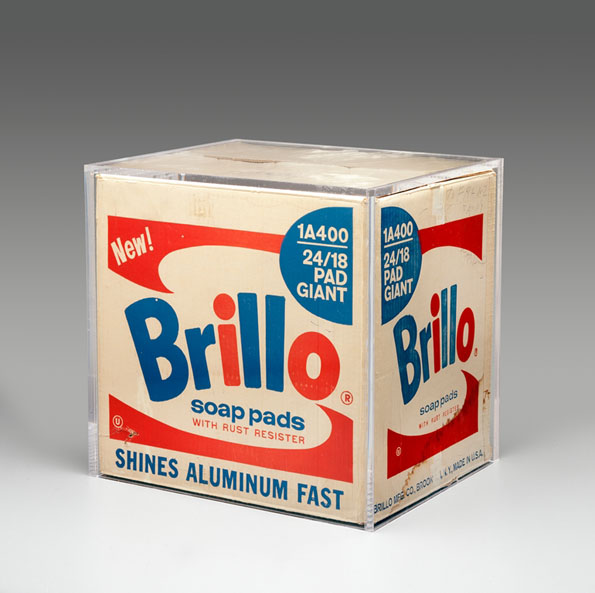
What the work itself elicits is far less important than the task of locating whatever happens to have turned up in the art galleries in some historical scheme. “To see something as art requires something the eye cannot descry—an atmosphere of artistic theory, a knowledge of the history of art; an artworld.” This statement bears close examination. The art world has trumped the art—and Warholism is born. “What in the end makes the difference between a Brillo box and a work of art consisting of a Brillo Box is a certain theory of art.... The world has to be ready for certain things, the artworld no less than the real one. It is the role of artistic theories, these days as always, to make the artworld, and art, possible.”

It means we do not have confidence in the experience of the eye itself, says Perl.

I'm not sure. Something seems confused and wrong about the show. Perhaps the basic point is that art should not simply be about cliques. Warhol democratized the avant-garde, in a sense, but also reinforces it. New cliques establish themselves by undermining the old cliques. Ideas are used simply as political weapons. And that cynicism seems deeply false.

Perhaps humans do yearn for pointers to the real, to deeper awareness, rather than simply signifiers of social inclusion and exclusion.


Saturday, November 17, 2012

Two Ways of Life

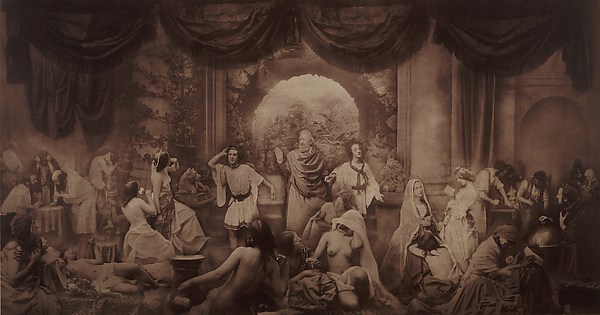
This is an interesting photograph, while we are talking about virtue and purpose yet again. It is by Swedish-English photographer Oscar Gustav Rejlander, and was assembled in 1857, near the dawn of photography.


It is from the Met's current exhibition "Faking it: Manipulated photographs before Photoshop." According to the Museum description of the picture:

The Two Ways of Life was one of the most ambitious and controversial photographs of the nineteenth century. The picture is an elaborate allegory of the choice between vice and virtue, represented by a bearded sage leading two young men from the countryside onto the stage of life. The rebellious youth at left rushes eagerly toward the dissolute pleasures of lust, gambling, and idleness; his wiser counterpart chooses the righteous path of religion, marriage, and good works.

It is not a single photograph, though. As I said above, it was asssembled, rather than capturing a single moment. The camera lies.

Because it would have been impossible to capture a scene of such extravagant complexity in a single exposure, Rejlander photographed each model and background section separately, yielding more than thirty negatives, which he meticulously combined into a single large print.

So it is a fascinating early example of a disjunction between photography and strict reported truth. The rest of the exhibition is excellent, and you should see it if you are in New York.

It is also an example of the leaden overwrought nature of Victorian morality. It is difficult to look at the picture without thinking of it as excessively didactic and mawkish, the kind of thing that gives any talk of virtue or aspiration a bad name, at least to our tastes. Perhaps one of the defining features of our age is a taste for irony or morals lightly worn (with a few exceptions). How do you ever talk about aspiration or virtue without seeming didactic or hypocritical?

The press and internet is full of the downfall of CIA Director David Patraeus, who seemed just a bit too perfect. It is very difficult to present the virtues as aspirations, something to aim for, rather than as empty didactic shells.

The two ways of life may be true in practice. We face choices in what we do, and our choices are not always good ones. But it is something that we often have to discover, rather than be told.


Saturday, October 13, 2012

Writing novels

Here's a lovely profile of Hilary Mantel, with much humane insight into writing and fiction. It took a long time languishing in semi-obscurity before she somehow hit it big with Thomas Cromwell. I talked about Bring Up the Bodies here.

(H/t AI Daily)


Thursday, September 20, 2012

The rot in the Apricot Garden

There's a magnificent exhibition at the Met of Chinese paintings of gardens and landscapes, which shouldn't be missed.

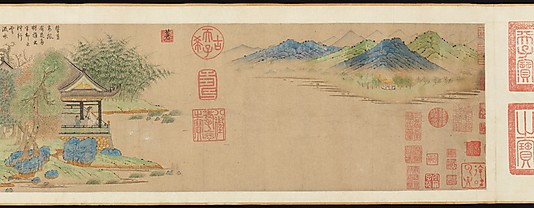
Many of the paintings evoke the scholar/gentleman at a pavillion lost in the mountains, contemplating nature, like this one, Wang Xizhi watching Geese.

They are a depiction of the refined good life, devoted to cultural accomplishment, and taking pleasure in simplicity and beauty and nature. It is a compelling vision.

But such paintings also frequently reflect a desire to find seclusion or peace in a very troubled world. The painting dates to around 1295, during the Yuan Dynasty established by Mongol invaders. Kublai Khan had destroyed the Southern Song Dynasty in the 1270s, and whole generation of scholar-officials had to come to terms with the loss of their world. This is a continuing theme throughout Chinese history of officials - selected by examination on the Chinese literary classics - seeking retreat from the intrigues of court or the corrupting practicalities of administration.

Sometimes the opposite problem occurs. There is a room in the exhibition which is focused on literary gatherings, including a scene of high officials gathering to look at paintings.

This, Elegant Scene in the Apricot Garden, depicts an actual meeting in 1437. It is a peak of cultural elegance and refinement, and power. But, as the museum write-up explains, there was a drawback.

One of the primary social functions of a Chinese garden was to serve as the setting for literary gatherings where like-minded friends might celebrate the season, enjoy music, or view rare antiquities, afterward composing poems to commemorate the event. Elegant Gathering in the Apricot Garden, attributed to the court artist Xie Huan, documents a historical event that took place in Beijing in 1437. On that occasion, nine of the most powerful officials in the realm gathered to enjoy painting, poetry, and other refined pursuits. Rather than be portrayed wielding emblems of political or military power, these men chose to emphasize their standing as scholar-gentlemen, highlighting the fact that, in China, status derived from one's command of cultural accomplishments.

These same men were also responsible for calling a halt to Admiral Zheng He's voyages of exploration, thus underscoring their belief that inward-oriented self-examination was more important than outward-looking exploration. Surrounded by oceans and deserts, and countries whose cultures they regarded as inferior, they saw China as a great walled garden, sufficient unto itself.

Isolation and decline followed.

There is a deeper point here. I was talking yesterday about the difference between "classical" and "modern" views of the good life. The classical view, according to Suits, confined intrinsic value to activities that only an elite could reach, like discussing philosophy - or sitting elegantly in the apricot garden. The modern view is more "democratic", simply valuing the process of playing games rather than particular ends.

So here we have a depiction of the problem with elites - they become self-satisfied and static and inward-looking. Their values and virtues tend to become corrupt.

Here, the picture is elegant and refined, but ultimately closed and empty and contemptuous of others.

This is so often the problem with trying to aim for higher levels in society. Elevation often turns corrupt or inert. Aristocracies or merchant princes turn into rentiers. Any respect for achievement declines as the elite turns rancid.


But the "democratic" view has its problems too, of vulgarity and anomie and cruelty, as we also saw this week with the nasty celebrity gossip industry.

Egalitarianism is often incompatible with flourishing or development. By default, there is no recognition for anything except wealth and power and glamor, because any other distinctions are illegitimate or ignored.

I was thinking about what led us to live in New York back in January ( apart from being able to go see exhibitions like this at the Met).


Is it freedom from we want here in New York, or freedom to, in Isaiah Berlin's old phrase?

Maybe that's the phase transition. We've had a century where we have - slowly and painfully - evolved institutions which deal with freedom from - want, hunger, violence, scarcity. But we haven't really begin to get our heads around the next stage, freedom to.

New York represents a kaleidoscope of experience and stimulation - freedom to do new things. But as a society we haven't decided whether we want to use freedom to do new things, or what it means for us.

This is our current picture of the good life, perhaps.

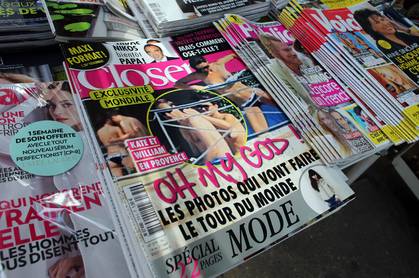
We have the picture here of the scholar in nature, the philosopher kings drinking tea and writing poetry, and the paparazzi photos of the future queen of England brought down to earth. Three very different worlds.


Sunday, September 16, 2012

Writing

This is encouraging, in a way. John McPhee, staff writer for the New Yorker and one of the most successful and accomplished nonfiction writers ever, author of over thirty books, describes his writing process:

It may sound like I’ve got some sort of formula by which I write. Hell, no! You’re out there completely on your own—all you’ve got to do is write. OK, it’s nine in the morning. All I’ve got to do is write. But I go hours before I’m able to write a word. I make tea. I mean, I used to make tea all day long. And exercise, I do that every other day. I sharpened pencils in the old days when pencils were sharpened. I just ran pencils down. Ten, eleven, twelve, one, two, three, four—this is every day. This is damn near every day. It’s four-thirty and I’m beginning to panic. It’s like a coiling spring. I’m really unhappy. I mean, you’re going to lose the day if you keep this up long enough. Five: I start to write. Seven: I go home. That happens over and over and over again. So why don’t I work at a bank and then come in at five and start writing? Because I need those seven hours of gonging around. I’m just not that disciplined. I don’t write in the morning—I just try to write.

I've read several of his books over the years, including Coming into the Country when I travelled around Alaska years ago, and Annals of the Former World about the geology of the North American continent. They are beautifully crafted, although very much about particular people as much as ideas. They are almost always very biographical, telling a story, which is no doubt what makes them more commercial, too.


Friday, September 7, 2012

Madonna at Yankee Stadium: Rancid

"So we paid a lot of money to be frightened, bored and alienated", says G to me this morning. "it was disgusting." And that from a long-time Madonna fan.

We went to the concert at Yankee stadium last night, after booking it months ago. We wanted to do it partially because we couldn't afford to back in the 80s or early 90s. Her music has been a background soundtrack for much of our lives, and who knows if she'd tour again. So we happily found ourselves having a beer in our seats and enjoying a perfect late summer evening before the show started.

The opening act, a Swedish DJ, was fun. Then there was an endless boring interval, delay, a void that sucked all the atmosphere out of the stadium.

The crowd grew restless. People behind us started yelling at any sign of activity. We wondered if the show had been cancelled for some reason. There's going to be trouble if this is off, G said to me. A lot of people have had a lot to drink, and they are not going to be happy.

Then, at 10.15 (the ticket said show starts at 8) Madonna finally deigned to take the stage. People were bored and irritated by this time, but relieved something was happening. The first act was visually stunning, with a video of a cathedral as backdrop.


Then the whole thing turned crude and repulsive. An appalling "I shot my lover in the head" segment repeatedly sprayed blood and brains across the screen, as she brandished a gun. The stadium thundered with the crack of gunshots. Shock and splatter. Violent. Sick.

G was visibly upset. It utterly destroyed the mood. Madonna followed it with a segment dominated by death and graveyards. Her new material fell flat, and there were too few of the older big hits.

At one point she shouted out from the stage, "let me hear you New York! Is this what 40,000 people sound like?" Well, no, it isn't. There was no electricity in the air. People stayed firmly in their seats, apart from the few big hits like Cherish or Vogue, where they rose and swayed a bit, willing themselves to want to dance and enjoy themselves. The spirit never took flight, though.

If it was supposed to be art, it's in its baroque, decadent phase. There's no new ideas. She still obsessively tweaks the Catholic Church, and thinks the gay agenda has something to do with free speech. I'm all for tweaking powerful institutions. But free expression isn't under threat for gays or liberals when most of the mainstream media and Hollywood is firmly committed to their agenda. They are the powerful establishment institutions. The hypocrisy was breathtaking, as she complained about her self-expression to a packed Yankee Stadium.

Instead, I was thinking of the 12-year old Christian girl who is under threat of execution for blasphemy against Islam in Pakistan. Much of her community was so frightened they fled into the surrounding forest. Madonna offered a baffling backdrop of an Indian train in one long segment. She's a trainspotter but can't spot the real political problems.

Coptic Christians in Egypt are under threat from the mob, now the Muslim Brotherhood is in power. Christians are being killed in Nigeria.

These are not fashionable victims for Madonna. I've just grown tired of that.

She's done it for years, of course, and I'm not Catholic. But she's behaving like a stalker on this. She actually benefits from the tolerance of Catholics and others who let her mock their symbols. If one of them dared to mock gay martyrs or causes, she'd be the first to shriek "bigot" if her taboos were violated, and want them jailed. It would be like the Salem witch trials.

She's a parasite on tolerance. If she wants to be edgy, let her put a crescent up there to be mocked as well.

The whole thing was dark, and claustrophobic, and full of resentment and hate and violence. She is a sick puppy.

It just feels as if is a sign that something has ended, that something in the culture is just self-destructively collapsing under its own weight. We own the DVD of her last tour, which is great. This is very different. You go to a big stadium concert to be swept up in huge collective emotion, to feel elation and joy. Instead, we felt, with a few exceptions, bored, baffed or nauseated.

There was something rancid and rotten about the whole thing. It ended at 12.15 am. She's past closing time.


Monday, September 3, 2012

Interaction, not isolation

Here is a wonderful example of cultural mixing and mash-up, not to mention creativity and originality: major movies portrayed in Persian miniature style.

Incidentally, the Met has some of the finest examples of original Persian miniatures in existence. The Shahnama of Shah Tahmasp , leaves from a fabulous illuminated book of the Iranian national epic, are tucked into a far corner of the new Islamic Wing.

As the Met description says,

The artistic importance of this manuscript cannot be overestimated. It is considered one of the highest achievements in the arts of the book for its superb calligraphy, painting, and illumination. From a pictorial point of view, it also marks the synthesis of the two most important phases of the Persian tradition—the Turkman style, which developed in Tabriz and Shiraz, and the Timurid style, associated with Herat.

They usually have six leaves of the books on display. It is one of the great cultural treasures of New York city, and absolutely worth seeing.

(h/t G!)


Tuesday, August 21, 2012

Artists and Dogs

G and I watched The Artist the other night on DVD. It's a beautifully shot movie, lyrical in its evocation of 1920s Hollywood. It's amazing that a French movie was devoted to Hollywood and shot in LA.

Incidentally, we debated for some tie whether Uggie the Dog stole the show or overacted. (Conclusion: stole the show!)

Uggie the Dog


Something about the movie resonated with enough people to deliver a Best Movie Oscar. Yes, it was a wonderful production. Yes, it was evocative movie nostalgia, which must play well with the Academy. But I wonder if the storyline - silent movie star is ruined by the advent of talkies, but eventually makes a partial comeback in dance - is part of the reason in itself. It's about fear of the disruptive effects of technological change. One minute you're up, living in a mansion and pictured on billboards. Next minute you're down. It's not just about the late 1920s.

Technological change is a frequent movie theme, of course - usually some malevolent robot or computer taking over the world, like Skynet or Hal. But this is about technology mixed with abrupt shifts in popular taste. G says it's like the fashion industry. One minute you're in, one minute you're out.


Monday, August 13, 2012

Closing Ceremony

The Olympic closing ceremony in London was much better than the opening ceremony, which we just detested in our house. Last night had an underlying tone of good-natured exuberance and joyfulness, instead of the stale sociology seminar of the opening. It was glamorous instead of earnest - the Spice Girls on their London taxis were particularly fun. The Eric Idle set was wonderful. There was more quirky individualism than dark satanic mills.

I'm still puzzled about why so many people think the opening ceremony was good. I think for many Brits the high point was the Queen's leap from the helicopter. There may have been much more of an impact and shocked surprise if you saw it live. We already knew about it because we had to wait for hours to see the ceremony on NBC, so it was already old news. And the Brits would get an extra thrill from the subversion of royal decorum.

But I still don't get the talk of "creative risk-taking" in Boyle's production. I think it's the old avant-garde "epater les bourgeois", in part, circa with "the artist" imagining they are being terribly daring but in reality bland and conventional and unimaginative. Boyle might as well have walked a giant lobster around the stadium for part of the show, and delighted the media in-crowd.

His vision of a "new Britishness" was just sad, a sort of slumdog hip-hop anomie, a last gasp of rewarmed Blairite Cool Britannia thinking. Actual Britishness turned out to be much better, in the enthusiasm of the crowds and triumphs of the Team GB athletes in the following two weeks.

NBC hit a new low last night, though. At 11pm, instead of showing the last act of the ceremony, they deferred it and showed an episode of a new show about vetinarians called Animal Practice.

Words fail me. Worst. Network. Ever. They may have got high viewing numbers from a captive audience but they should never be allowed to cover a major event again.


Saturday, August 4, 2012

Beauty and the sublime

I was talking about the art market a week or two ago, and what it says about our wider desires and purposes. I happened to read Venus in Exile: The Rejection of Beauty in Twentieth-Century Art in the last few days. The author is Wendy Steiner, who teaches English at U Penn and sits on some prominent prize award boards.

The book is a daringly ferocious criticism of modernism, and with it much of the "wasteland" of twentieth-century aesthetics and art. She argues modernism shunned beauty for a century, in favor of an aesthetics based on the Kantian sublime.

In modernism, the perennial rewards of aesthetic experience - pleasure, insight, empathy- were largely withheld, and its generous aim, beauty, was abandoned (page xv)

Kant thought of the sublime as an experience of limitless, of awe, of power.

Kant and Burke bequeathed to the West a taste for the sublime, an aesthetic experience in which beauty is a confrontation with the unknowable, the limitless, the superhuman. (5)

The sublime is pure and separate from personal interest, in a way the beautiful is not. Judgement of beauty is disinterested, impartial, autonomous and hence an exercise of freedom.

The main symbol of beauty had been the female subject, certainly in the nineteenth century, she says. The avant-garde did away with this.

Indeed, the history of twentieth century elite art is in many respects a history of resistance to the female subject as a symbol of beauty. (xix)

Mary Shelley was one of the first to question this, in Frankenstein. The creator sees his family killed and ends up wandering on the Arctic ice.

Mary Shelley thus pointed out the irony of the sublime: that in providing supposedly the most human of mental states, freedom, it utterly disregards love and family and pleasure, which have at least as much claim as freedom to define the "human". 9p13)

Steiner quotes Barnett Newman, who explicitly said in 1948 "The impulse of modern art is the desire to destroy beauty." (p111)

Instead, the beautiful was dismissed as the merely charming. Abstract form became more important than concrete reality, or the bourgeois notions of harmony, comfort, order or happiness. And there was a condescending interest in the "Other."

From expatriatism to the Jazz Age and the Surrealist's fascination with the "Imp of the Perverse' and the Marquis de Sade, modernists sought out the thrilling "other" to eperience the allure and charm they had eliminated from their art. (p49).

In practice, Kantian abstraction and sadistic interest went together.

The Outsider is the latest incarnation of the trouble with beauty in twentieth-century art, a replacement for the female subject and the process of intersubjective discovery she entails. In its fetishism modernism focused on various figures: the tribesman, the simpleton, the madman, the racial or social outcast. The avant-garde artist used the foreigness of the Other to perpetuate its sublime alienation. The self could be sought but never recognized in the Other, who is available for appropriation but never mutuality, empathy, respect. (p189)

It also entailed the rejection of "ornament".

Ornament belongs to the realm of play rarher than work, and its dominance implies the upset of the practical, pragmatic world. It threatens the notion of universal truth and value, being most subject to obsolescence. The dominance of an ornamental aesthetic would imply the suppression or outright dismissal of atemporal and ahistorical claims for art. Art would be understood as contextual, unabashedly adverstising its disdain for eternity.(p61)

Much followed from this - a rejection of the domestic sphere, for example, with its striving for charm and pleasure and harmony, and filled with feminine respectability and ornament. Constant impersonal and formal innovation was preferred.

There was a rejection of connection.

The avant-garde sensibility called for a deliberate estrangement of the artist from his subject. (p153)

In romance, the point is not to plunge oneself into strangeness and alterity forever, but to experience an Other so as to come home to a new self. Modernism, wedded to the heartless sublime, blocks any such accommodation. To the avant-garde sensibility, the achievement of a satisfying self-realization with an Other is a compromise, a retreat from transcendence. (p151-152).

Beauty, she says, is finally making a comeback since the late 1990s. Arid abstraction has run its course, but much of the arts establishment is still steeped in modernist thinking.

It is the task of contemporary art and criticism to imagine beauty as an experience of empathy and equality.(p xxv)

She develops her argument with a myriad of examples ranging from Bonnard to Basquiat, from Matisse to Rothko, from Don DiLillo to Phillip Roth. It's quite fascinating, even just as a display of intellectual fireworks. It is also one persuasive way to talk about art history - although for a subject as complicated and diverse as modernism, I suspect there is no entirely satisfactory explanation. And of course there could be any number of counterexamples.
I'd have to go back to the original thinking in Kant, and even before, to be convinced. I wonder if the sublime can be traced back before Kant and Burke - and I am not sure. I also wonder whether particular kinds of people are attracted to the sublime, and always have been. The answer is probably that before the eighteenth century and the enlightenment, these feelings were primarily expressed as a religious impulse. And so modernism is a deeper stream resurfacing, a strange civic religious mixture of austerity, puritanism and antinomianism.

The question is is Steiner's story an illuminating way to look at twentieth century art. I would have to say absolutely, although it cannot be the only one.

It also makes me think about the deep concerns about the aestheticization of politics that I mentioned regarding the Olympic opening ceremony. These apparently remote aesthetic deliberations can have vast consequences if, in Neronian style, leadership or government is confused with art. I've talked a lot on this blog about the need for more of an emphasis on purpose and on what people actually want out of daily life. In some ways that is a more connected, domestic kind of vision than some grand universalistic new order. It is much more friendly to beauty than the daring heights and terrifying abysses of the sublime.

Beauty also has a fundamental role in any conception of the good life.


Perhaps some people will never be attracted to a more attainable form of happiness - or, indeed, even happiness itself. We saw in Sarah Ahmed's book the Promise of Happiness a preference for the heroic political struggle for the "mayhap" over any conventional happiness, for example.

Aesthetics will affect the ends that people choose for themselves, and the ends that they even see. It rolls together ideas about connectedness, relations with others, autonomy and freedom, beauty and harmony and order which can be all the more insidiously powerful because they are not explicit - but just presented as matters of taste, of "comme il faut". One is seen as a rube for even questioning the implied ethics. Indeed, this is what class largely is these days, a set of unspoken norms and mannerisms and correct attitudes.

Taste is perhaps the least and most political thing of all.


Sunday, July 22, 2012

Art and Evolution

We were discussing why people want to produce art last week. Here's a long article in the New Republic on whether our art instinct can be explained in evolutionary terms.

Today’s Darwinists treat the aesthetic as if it were a collection of preferences and practices, each of which can be explained as an adaptation. But the preferences and the practices are secondary, made possible only by the fact that the aesthetic itself is a distinct dimension of human experience—not the by-product of something more fundamental, but itself fundamental. This dimension is defined in many ways—by its love of the hypothetical, of order and symbol, of representation for its own sake, of the clarity that comes from suspending the pragmatic; and it has, perhaps, as much in common with theoretical knowledge and contemplation as it does with sensory enjoyment. The “usefulness” of this whole way of being is what must be explained, if there is to be a plausible Darwinian aesthetics. Even if there were, it is hard to see how it would change the way we experience art, any more than knowing the mechanics of the eye makes a difference to the avidity of our sight

The article leads off from Denis Dutton's book The Art Instinct: Beauty, Pleasure, and Human Evolution, which I haven't read yet but hope to get to. 

Friday, July 13, 2012

What is the value of second-tier art?

We've been travelling around the Southwest on vacation this week. We passed through Taos, NM a few days ago. Taos is a beautiful little arts town, centered around its adobe-built plaza and pueblo revival buildings. There are dozens of little galleries. The roads throughout the surrounding area have signs for "pottery this way" or "working artist." There are hundreds of artists resident in the area.

How do people make a living at it? Commercial art galleries always seem so deserted, with one staff member always at a corner desk hidden behind a computer and trying to look busy. I'd be surprised if they make more than two or three sales on a good day. The average for a painting or sculpted mirror in the area is around $750 up. Of that, probably less than half goes to the artist, and they no doubt have to pay tax on that. Better known artists in the main galleries sell for $5000 or more. Even the, only a few make a very good living. There is a limited market.

In economic terms, it's a tournament, like a sports league that starts with a hundred teams and ends up with one winner. Thousands start in the arts, only a few rise to the pinnacle and capture most of the fame and financial rewards. Success is inherently scarce. The rest hope for an occasional sale in a small gallery, but are mostly frustrated and obscure.

Most of the arts are like this. Only a tiny proportion of actors, musicians, rock bands, painters, ceramicists, opera singers "make it." Some of it is a matter of talent rising to the top, of course. But often it is sheer chance - which is why I suspect so many Hollywood artists trend liberal, as they have a sense that their wealth was chance rather than earned or justified. And very often success is a matter of skill at manipulating connections and contacts.

Art and money mix in strange ways. Selling art wraps together many different issues and flash points. It is tangled with wealth. In many cases, art IS wealth, the clearest expression of wealth that exists. The loot of the robber barons, like Frick and Carnegie and Getty and Morgan, ended up as treasure houses of art. Miners and steelworkers and wildcatters toiled for decades to produce the wealth that funded the great American museums, where their sweat has been transmuted into Picassos and Serras.

People naturally incline to spend more money in aesthetic pursuits as they grow wealthier. The first generation often makes a fortune in meat processing or engineering or finance. The children and grandchildren spend it on art. The Millicent Rogers Museum in Taos is one example. The Allerton Gardens in Kaui is another. Trust fund babes hang out in Williamsburg and write novels.

Art is tangled up with status, of course, all the more so as people increasingly have access to the same mainstream goods. You can't buy a better iPad even if you are a billionaire. They sell Prado and Armani in midwestern department stores. But you can put unique and expensive art on your walls.

Taste is the real class marker more than money.

And art is always tangled up with expression of particular values. Art is often the secular religion of the modern world, MoMA or LACMA its cathedrals. It is an expression of identity and state power and patronage.

So thinking about art, in both its aesthetic and commercial senses, tells us a lot about what people want and value when they are not materially constrained. It tells us a lot about how society may evolve in the future, as it grows wealthier. We may (hopefully) spend more wealth on beauty and aesthetic pleasure. But the art world also carries other less attractive features. It is hierarchical. It is bitchy. It is faddish and political. People can express themselves. And they can also be ignored and disdained and excluded.

There are many tiers in the art world, and despite an illustrious past Taos is not up there with New York galleries or Art Basel or the Venice Biennale.(Seven Days in the Art World is a fascinating insight into that sphere.)

The bottom tier is the souvenir and craft shops around the plaza in Taos ("schlocky", says the local guidebook). People buy turquoise necklaces and fridge magnets and made-in-china navajo rugs. Why? The human aesthetic instinct and a desire for decoration. Memories, something to give Aunt Mabel. Buying something a little more exotic than is readily available at home. It's not expensive, and it's not "art", of course. But it is aesthetic pleasure, and even average joe can buy a necklace chain for his wife with joy.

A step up from that is the second-tier galleries, which in Taos are located a block or two off the plaza. There must be so many people who paint or pot primarily as a means of self-expression, even if it means a fairly threadbare existence.

This is a fascinating thing. I've been talking throughout this blog about focusing the economy more on the ends of flourishing, developing the good life, because the sheer efficiency of the market economy is saturating lower levels of basic survival needs. For a lot of people, producing mediocre art is the thing they would love most of all to do. Is this a bad thing?

Getting into even a second-tier commercial gallery in a small remote town is an achievement in itself, something that most aspiring daubers never do. But walking around many of the smaller galleries it is difficult to avoid the thought that much of it is not very good. Real aesthetic talent stands out when you see it.

How can we tell? After all, perhaps it needs a very discriminating eye to evaluate it - although clearly the galleries here are appealing to well-healed tourists who might suddenly fall in love with a painting at random. Yet the art in the better, more expensive galleries immediately seems so much better. (We liked this one).

Finally, there is the top tier art, the realm of Sotheby's and museum curators and the jet set. There are the collectors and the dealers and the PR people. It is the art market. It is art for display and investment and scholarship, rather than love.

Yet the market tends to yield to public goods after a while. Private owners donate to public museums, and the greatest art becomes the common heritage, the common-wealth of people. Over time, the stock of those public goods, those assets, steadily grows. Maybe that tells us something too. The nature of posession changes as we go up the hierarchy of needs.

A thought experiment

Let's imagine we have an economy which before long lets people do just what they want - perhaps not at a lavish standard of living, but free to spend time as they choose. (We imagined a desert island back here). Maybe some people will just sit at the bar all day. But a lot of people will dearly love to paint, or write bad novels, or poetry, or ceramics. They will want to sit around in espresso bars and debate the latest trends. There's inherent motivation to do so.

Let's say ordinary people have more chance to indulge their aesthetic inclinations, as only rich heiresses could do in the past. What kind of society does that produce?

There is surely an independent value in having many more people able to paint and write and play in a band, even if society ends up with more unread novels and unplayed music tracks. It isn't something that many people will pay much for, of course. The exchange value is low. But there is value in letting people flourish and develop their talents - and some of it wil turn out to be astonishingly good. Perhaps more of the work will circulate by gift and exchange and donation than it ever would if people have to sell it to make a living. Perhaps everyone can have mediocre original art on their walls.

This is one of the fundamental issues we will have to confront as the economy evolves. A lot of the things people want to do have little or no market or exchange value. But people want to do them anyway. And the wealtheir or less constrained they get, the more they want do to them.

Will real aesthetic value drown in a sea of medocrity? Publishers and editors and gallery owners used to sift out the gems from the dross. But there is scope for lots of little worlds, little scenes, small groups. You may never be recognized as a major international artist. But you may be recognized as significant in Taos circles, or even in your church or reading group or extended family.

In any case, it is getting harder to define quality, at least beyond a minimum qualifying threshold. The gatekeeper role is breaking down in so many areas. You don't have to have a contract with a major publisher or know the right literary circles to get published as a novelist any more. You can upload to the world on Kindle, and it's increasingly not clear that Simon & Schuster or Penguin can market your book any better than you can. Choosing the next big hit has always involved some luck, as the rejction slips for plenty of famous novels and screenplays show.

Making it big in the art world is potentially corrupt, as well. The Poetry world, for example, seems to revolve around people giving those they know prizes and vice versa. Committees and art seem to repel each other.

Maybe we will get more mediocrity. But maybe we will also get more plurality and differetiation and local presence.

Maybe we will get less modernist originality, at least in aggregate. But we may get more beauty. A little extra aesthetic beauty can be transformative, and not even that expensive in monetary terms. A little extra design talent could alter the living conditions of all the people who live in deeply ugly tower blocks and cookie-cutter mansions.

Talent still matters. But perhaps even bad art is better than no art.

Maybe the second-tier art sometimes needs more of a purpose or an idea. It isn't always clear if the fault is in what the artist thinks will sell to uneducated consumers - demand rather than supply. And perhaps the artist's perspective often is just not that interesting. Self-expression as such just isn't that interesting to other people if it does not resonate with more universal themes. The great art of the past was mostly linked to much larger themes or subjects - religious expression in quattrocento Florence, status markers of elite taste (everywhere and at all times), particular commercial imperatives or market demand, like portraitture in golden age Dutch art. Maybe it is a matter of more education, so that the art says something.


All art is quite useless, Oscar Wilde famously said. But the little latte towns and tourist-trap galleries and craft stalls tell us something about what people want if they are given the chance. It tells us something about the good life. The value of second-tier art is letting people flourish and develop their talents. And maybe occasionally other people might like it.


Wednesday, June 6, 2012

Tudor Psychological Chills


I read Hilary Mantel's new novel, Bring Up the Bodies: A Novel last week as well, about Thomas Cromwell and the fall of Anne Boleyn in sixteenth century England. The successor to her Booker-Prize -winning Wolf Hall: A Novel, it is a chilling evocation of politics and court psychology around Henry the Eighth in the mid-1530s.

I greatly enjoyed it, even if I had to take breaks from confronting the conniving fractiousness and cruelty of humanity in the book. It is absorbing and evocative, although not quite as rewarding as Wolf Hall. Cromwell is established and powerful. It is less intrinsically interesting and dramatic than the story of this rise to the top.


Nor is Anne Boleyn a particularly interesting or attractive character. Instead, the chief angle is the dreadful spectacle of how someone like Anne can fall so quickly and terribly. Just three years after her triumphant marriage, she is beheaded in 1536 by a French swordsman on a platform in the Tower of London.


The history is familiar. But Mantel brings it alive with vividness and insight.


Sunday, May 6, 2012

Accomplishment and purpose in the Arts


We've talked about Charles Murray before on this blog. Indeed there is a link in the last post below to his argument the welfare state has drained the life out of life. 

Here is a new essay in which he argues that the arts in America will not flourish if there is no deeper sense of purpose. And elites have been avoiding that for decades.


Murray wrote a book in 2004 about the conditions necessary for human achievement to flourish (which I haven't read for now.) And he has been thinking since about what it means for the prospect of a renaissance in the arts in America.

We have the wealth and the infrastructure for great artistic achievement, of course. But this is not sufficient. Look at how little Europe has achieved in the arts in the last fifty years, he observes. Why ?

For him, the answer is Europe has lost confidence and vitality. There needs to be some sense of purpose in the culture for great art, he says. Without it, there is no urgency to make your mark, or do anything other than live and pass time pleasantly. There is less sense of "this-is-what-I-was-put-on-earth-to-do" calling which is necessary to master a field over many years.

In trying to think about how a renaissance might happen, I cannot put aside the strongest conclusion that I took away from the work that went into Human Accomplishment: Religiosity is indispensable to a major stream of artistic accomplishment.
Religiosity does not have to mean specific religious observance, however:

By “religiosity” I do not mean going to church every Sunday. Even belief in God is not essential. Confucianism, Daoism, and Buddhism are not religions in the conventional sense of that word—none postulates a God—but they partake of religiosity as I am using the word, in that that they articulate a human place in the cosmos, lay out understandings of the ends toward which human life aims, and set standards for seeking those ends.


In fact, it points back to Aristotle - which is why I find the essay particularly interesting.

A secular version of this framework exists, and forms a central strand in the Western tradition: the Aristotelian conception of human happiness and its intimate link with unceasing effort to realize the best that humans have within them. In practice, we know that the Aristotelian understanding of human flourishing works. A great many secular people working long hours and striving for perfection in all kinds of jobs are motivated by this view of human life, even if they don’t realize it is Aristotelian.

There needs to be a sense of transcendental goods for a society (and the arts) to flourish - some anchoring in conceptions of truth, beauty, and the good life. And that recalls Aristotle. In Murray's words,

When applied to human beings, the essence of “the good” is not a set of ethical rules that one struggles to follow, but a vision of human flourishing that attracts and draws one onward.
Without some conception of the good, art tends to become vulgar,

This for me is the huge lesson I've learned from reading Aristotle and work on virtue ethics. Morality and society are not just a matter of following universalized rules, or procedural neutrality, as we've generally come to believe. There has to be some concrete sense of the good life, and what flourishing means. It's not just an ethical issue. It's also an economic issue, because it has a fundamental impact on what we want the economy to do and how we want it to evolve.


State neutrality does not mean that everyone is free to develop their own conception of the good life. It just means the state tends to crowd out and dominate all other efforts and initiatives.

Murray says we have tried to ignore the big questions about purpose for too long. But that must ultimately change.

The falling away from religiosity that we have seen over the last century must ultimately be anomalous. From the Enlightenment through Darwin, Freud, and Einstein, religiosity suffered a series of body blows. The verities understood in the old ways could not survive them. Not surprisingly, new expressions of those truths were not immediately forthcoming, and the West has been wandering in the wilderness.

It won’t last forever. Humans are ineluctably drawn to fundamental questions of existence. “Why is there something rather than nothing?” is one such question. “What does it mean to live a good life?” is another. The elites who shape the milieu for America’s high culture have managed to avoid thinking about those fundamental questions for a century now. Sooner or later, they’ll find it too hard.

Liberalism evolved out of a desire to eliminate bloody conflicts over religiosity and the good life. But avoiding a conception of the good life altogether is not a durable answer either.

(h/t Arts and Letters Daily)


Sunday, April 22, 2012

The Magical Chorus

A quick word about Magical Chorus: A History of Russian Culture from Tolstoy to Solzhenitsyn (Vintage) by Solomon Volkov, which I read because someone kindly bought it for me as a gift. It is a good read but there are so many tragic stories.

The book revolves around the Russian intelligentsia - writers, film-makers, dancers, composers - and their fate during the upheavals of the twentieth century.

Much of it is the usual gossip and catty rivalry between different artistic groups, as one faction rises and another falls, from Tolstoy through Gorky, Eisenstein, and Sholokhov, Pasternak, to Yevtushenko, and Solzhenitsyn. It is a book about Russian modernism in the 1920s and socialist realism in the 30s and 40s, and it makes for a constellation of great names in the arts.

But it is against the backdrop of violent revolution, exile, purges, the camps, and the terror.

Stalin was well-read and kept up with the latest literary periodicals. High culture gratifyingly received attention at the highest levels of state - but sometimes with grave results. And not even great talent was a protection against the knock on the door.


One story is that of the artist Alexander Drevin and his wife Nadezhda Udaltsova. Drevin was arrested in February 1938. According to Volkov,

..he was exectuted ten years later in a Stalinist prison. Udaltsova was not told of her husband's death, and she continued submitting appeals for his pardon for almost twenty years, before she learned the horrible truth in 1956.

But the intelligentsia was important to the state, and to the wider culture.

That did not last. The book concludes in the 1990s, when society opened up - but official money for high culture collapsed. And Russia become more interested in gameshows than poetry.

Monday, January 30, 2012

Even Periclean Athens behaved foolishly.

I watched a PBS documentary on Netflix about the catastrophes that befell Periclean Athens. Then yesterday I was wandering around the Met museum, looking at the new Renaissance Portraits Exhibition, the new galleries in the American wing, and then the Classical galleries on the way out.


The classical galleries got me thinking. Consider the clarity and glory of classical Athens at the peak of its achievement. Here was a city that had led the defeat of the terrifying Persian Empire. Athens had become spectacularly wealthy from trade and tribute, and had just finished building the Parthenon. It essentially invented drama and phiIosophy and science. It was in the most remarkable cultural efflorescence there has ever been. 


And within a few years they are huddling inside their walls, dying of the plague while the Spartans ravage the countryside and farms around the city. 


The Parthenon was substantially finished by 438 BC. The plague struck in 430, during the long siege of the city as people crowded inside the walls. The Parthenon was only eight years old when it was surrounded by sickness and hunger and defeat. 


According to Thucydides, morality and social order broke down, as people thought they would soon die anyway, regardless of whether they did right or wrong.


The Peloponnesian war turns Greek against Greek and grinds on for thirty years. Pericles falls ill and dies. The city lurches into the military catastrophe of the Syracusan expedition. Socrates is found guilty of corrupting the young, and executed.


And so I was looking at the vases and other art from Athens in the fifth and fourth centuries BC, and thinking about how such talent also coexisted - or declined - into such idiocy and tragedy. The spectacular glory of Periclean Athens didn't last. 


I also wondered around the Late Roman displays, over by the south-facing windows. A great ungainly, ugly bronze of a late Roman emperor, Trebonianus Gallus, stands there, alongside a sign talking about the chaos of his times, dislocation and breakdown under the Severan Empires. He ruled two years before being killed by his troops in murky circumstances. He looks bloated and crude and misshapen and ugly. 


It makes the idea of a morality pill more attractive, for all the concerns about free will it raises. Then again, someone would start developing amorality pills to give them an edge in power. It is difficult to get people to work well together for long. I'm feeling that at work right now too.